| Volltext anzeigen | |
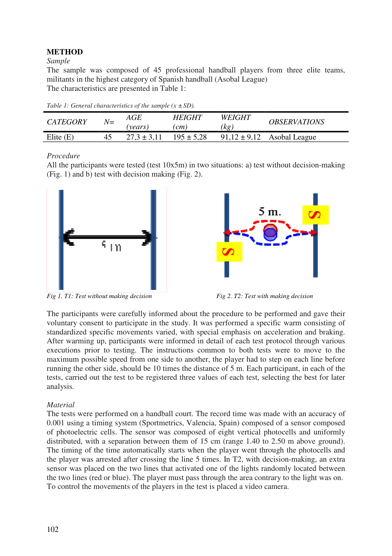
103 Statistical analysis Means and standard deviations of the variables were calculated. Also, we applied the Pearson correlation coefficient to analyze the relationship between these variables and the t test to analyze differences between means of the players belonging to the study sample. Statistical calculations were performed with SPSS 10.0. RESULTS AND DISCUSSION According to the review made, it was found that there was little research to analyze the relationship and differences between fitness test with and without making-decision. The movement speed without making decision was 5% better than with decision-making (p <0.01, t = 7.601, df = 44). The relationship between the two tests was positive and moderate (r = 0.812, p <0.01). More specifically, the value of T1 was better than the T2 in the three groups analyzed, the differences being around 5% and statistically significant (p<0.01). This seems to be consistent with the data obtained by Pardo et al. (2007) who obtained much higher values in throwing velocity without opposition than with opposition. In contradiction with these data is the research done by Lopez (2005) which, although found differences in the prior steps of the jump throw , obtained similar values in throwing velocity with and without opposition. This contradiction could be due to the throwing technique is very different to that carried out at the standing throw done in the present study. However, the data obtained in this study correspond to the two other studies (Van der Wende, 2005, Vila et al., 2009). Both studies found differences in throwing velocity with and without opposition, lower values observed in the presence of the goalkeeper. However, these investigations were conducted in another sport, water polo. On the other hand, the fact that the correlation values between the two speed tests are not high could be a significant finding that corroborates the differences between both tests. In this sense, it is noteworthy that, although both tests have a similar technique, the relationship is not high. This could be due to the marked differences in the degree of cognitive involvement and decision making of the two situations described in the study. CONCLUSIONS Decision-making influences the speed of displacement, decreasing it. The relationship between movement speed without and with decision-making is positive and significant. Therefore, we consider important to continue conducting studies on the influence of cognitive factors in specific physical capabilities , suggesting the possibility that these factors may also influence the specific physical condition of other team sports. _ _ _ _ _ _ _ _ _ _ _ _ jesus.rivilla@upm.es | |
 « |  » |
|
» Zur Flash-Version des Livebooks | |