| Volltext anzeigen | |
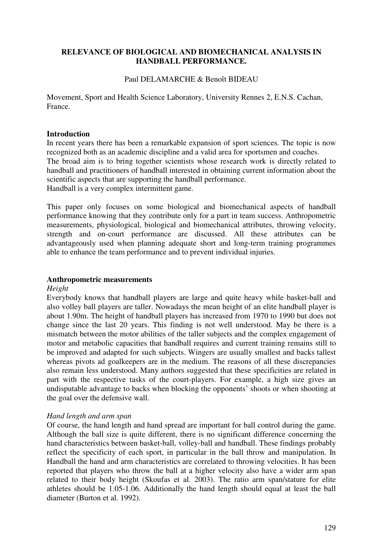
129 RELEVANCE OF BIOLOGICAL AND BIOMECHANICAL ANALYSIS IN HANDBALL PERFORMANCE. Paul DELAMARCHE & Benoît BIDEAU Movement, Sport and Health Science Laboratory, University Rennes 2, E.N.S. Cachan, France. Introduction In recent years there has been a remarkable expansion of sport sciences. The topic is now recognized both as an academic discipline and a valid area for sportsmen and coaches. The broad aim is to bring together scientists whose research work is directly related to handball and practitioners of handball interested in obtaining current information about the scientific aspects that are supporting the handball performance. Handball is a very complex intermittent game. This paper only focuses on some biological and biomechanical aspects of handball performance knowing that they contribute only for a part in team success. Anthropometric measurements, physiological, biological and biomechanical attributes, throwing velocity, strength and on-court performance are discussed. All these attributes can be advantageously used when planning adequate short and long-term training programmes able to enhance the team performance and to prevent individual injuries. Anthropometric measurements Height Everybody knows that handball players are large and quite heavy while basket-ball and also volley ball players are taller. Nowadays the mean height of an elite handball player is about 1.90m. The height of handball players has increased from 1970 to 1990 but does not change since the last 20 years. This finding is not well understood. May be there is a mismatch between the motor abilities of the taller subjects and the complex engagement of motor and metabolic capacities that handball requires and current training remains still to be improved and adapted for such subjects. Wingers are usually smallest and backs tallest whereas pivots ad goalkeepers are in the medium. The reasons of all these discrepancies also remain less understood. Many authors suggested that these specificities are related in part with the respective tasks of the court-players. For example, a high size gives an undisputable advantage to backs when blocking the opponents’ shoots or when shooting at the goal over the defensive wall. Hand length and arm span Of course, the hand length and hand spread are important for ball control during the game. Although the ball size is quite different, there is no significant difference concerning the hand characteristics between basket-ball, volley-ball and handball. These findings probably reflect the specificity of each sport, in particular in the ball throw and manipulation. In Handball the hand and arm characteristics are correlated to throwing velocities. It has been reported that players who throw the ball at a higher velocity also have a wider arm span related to their body height (Skoufas et al. 2003). The ratio arm span/stature for elite athletes should be 1.05-1.06. Additionally the hand length should equal at least the ball diameter (Burton et al. 1992). | |
 « |  » |
|
» Zur Flash-Version des Livebooks | |