| Volltext anzeigen | |
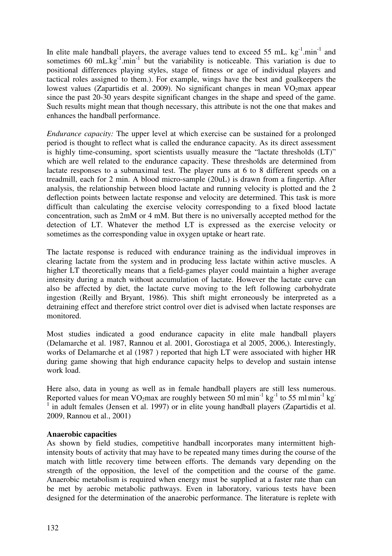
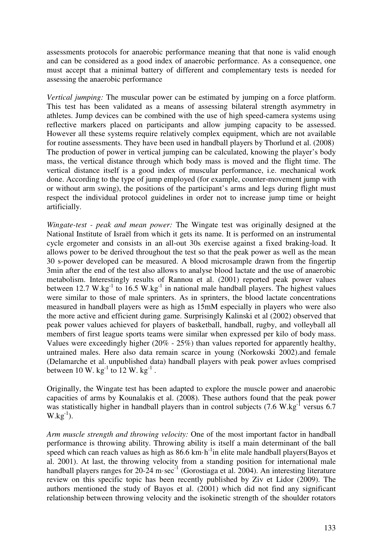
133 assessments protocols for anaerobic performance meaning that that none is valid enough and can be considered as a good index of anaerobic performance. As a consequence, one must accept that a minimal battery of different and complementary tests is needed for assessing the anaerobic performance Vertical jumping: The muscular power can be estimated by jumping on a force platform. This test has been validated as a means of assessing bilateral strength asymmetry in athletes. Jump devices can be combined with the use of high speed-camera systems using reflective markers placed on participants and allow jumping capacity to be assessed. However all these systems require relatively complex equipment, which are not available for routine assessments. They have been used in handball players byThorlund et al. (2008) The production of power in vertical jumping can be calculated, knowing the player’s body mass, the vertical distance through which body mass is moved and the flight time. The vertical distance itself is a good index of muscular performance, i.e. mechanical work done. According to the type of jump employed (for example, counter-movement jump with or without arm swing), the positions of the participant’s arms and legs during flight must respect the individual protocol guidelines in order not to increase jump time or height artificially. Wingate-test peak and mean power: The Wingate test was originally designed at the National Institute of Israël from which it gets its name. It is performed on an instrumental cycle ergometer and consists in an all-out 30s exercise against a fixed braking-load. It allows power to be derived throughout the test so that the peak power as well as the mean 30 s-power developed can be measured. A blood microsample drawn from the fingertip 3min after the end of the test also allows to analyse blood lactate and the use of anaerobic metabolism. Interestingly results of Rannou et al. (2001) reported peak power values between 12.7 W.kg-1 to 16.5 W.kg-1 in national male handball players. The highest values were similar to those of male sprinters. As in sprinters, the blood lactate concentrations measured in handball players were as high as 15mM especially in players who were also the more active and efficient during game. Surprisingly Kalinski et al (2002) observed that peak power values achieved for players of basketball, handball, rugby, and volleyball all members of first league sports teams were similar when expressed per kilo of body mass. Values were exceedingly higher (20% 25%) than values reported for apparently healthy, untrained males. Here also data remain scarce in young (Norkowski 2002).and female (Delamarche et al. unpublished data) handball players with peak power avlues comprised between 10 W. kg-1 to 12 W. kg-1 . Originally, the Wingate test has been adapted to explore the muscle power and anaerobic capacities of arms by Kounalakis et al. (2008). These authors found that the peak power was statistically higher in handball players than in control subjects (7.6 W.kg-1 versus 6.7 W.kg-1). Arm muscle strength and throwing velocity: One of the most important factor in handball performance is throwing ability. Throwing ability is itself a main determinant of the ball speed which can reach values as high as 86.6 km·h-1in elite male handball players(Bayos et al. 2001). At last, the throwing velocity from a standing position for international male handball players ranges for 20-24 m·sec-1 (Gorostiaga et al. 2004). An interesting literature review on this specific topic has been recently published by Ziv et Lidor (2009). The authors mentioned the study of Bayos et al. (2001) which did not find any significant relationship between throwing velocity and the isokinetic strength of the shoulder rotators | |
 « |  » |
|
» Zur Flash-Version des Livebooks | |