| Volltext anzeigen | |
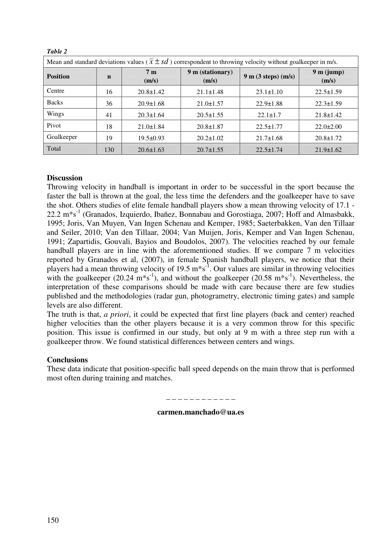
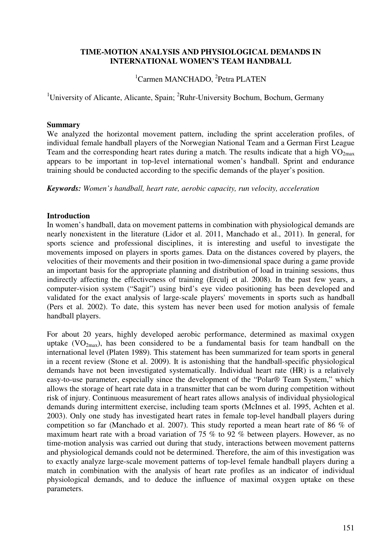
151 TIME-MOTION ANALYSIS AND PHYSIOLOGICAL DEMANDS IN INTERNATIONAL WOMEN’S TEAM HANDBALL 1Carmen MANCHADO, 2Petra PLATEN 1University of Alicante, Alicante, Spain; 2Ruhr-University Bochum, Bochum, Germany Summary We analyzed the horizontal movement pattern, including the sprint acceleration profiles, of individual female handball players of the Norwegian National Team and a German First League Team and the corresponding heart rates during a match. The results indicate that a high VO2max appears to be important in top-level international women’s handball. Sprint and endurance training should be conducted according to the specific demands of the player’s position. Keywords: Women’s handball, heart rate, aerobic capacity, run velocity, acceleration Introduction In women’s handball, data on movement patterns in combination with physiological demands are nearly nonexistent in the literature (Lidor et al. 2011, Manchado et al., 2011). In general, for sports science and professional disciplines, it is interesting and useful to investigate the movements imposed on players in sports games. Data on the distances covered by players, the velocities of their movements and their position in two-dimensional space during a game provide an important basis for the appropriate planning and distribution of load in training sessions, thus indirectly affecting the effectiveness of training (Erculj et al. 2008). In the past few years, a computer-vision system (“Sagit”) using bird’s eye video positioning has been developed and validated for the exact analysis of large-scale players' movements in sports such as handball (Pers et al. 2002). To date, this system has never been used for motion analysis of female handball players. For about 20 years, highly developed aerobic performance, determined as maximal oxygen uptake (VO2max), has been considered to be a fundamental basis for team handball on the international level (Platen 1989). This statement has been summarized for team sports in general in a recent review (Stone et al. 2009). It is astonishing that the handball-specific physiological demands have not been investigated systematically. Individual heart rate (HR) is a relatively easy-to-use parameter, especially since the development of the “Polar® Team System,” which allows the storage of heart rate data in a transmitter that can be worn during competition without risk of injury. Continuous measurement of heart rates allows analysis of individual physiological demands during intermittent exercise, including team sports (McInnes et al. 1995, Achten et al. 2003). Only one study has investigated heart rates in female top-level handball players during competition so far (Manchado et al. 2007). This study reported a mean heart rate of 86 % of maximum heart rate with a broad variation of 75 % to 92 % between players. However, as no time-motion analysis was carried out during that study, interactions between movement patterns and physiological demands could not be determined. Therefore, the aim of this investigation was to exactly analyze large-scale movement patterns of top-level female handball players during a match in combination with the analysis of heart rate profiles as an indicator of individual physiological demands, and to deduce the influence of maximal oxygen uptake on these parameters. | |
 « |  » |
|
» Zur Flash-Version des Livebooks | |