| Volltext anzeigen | |
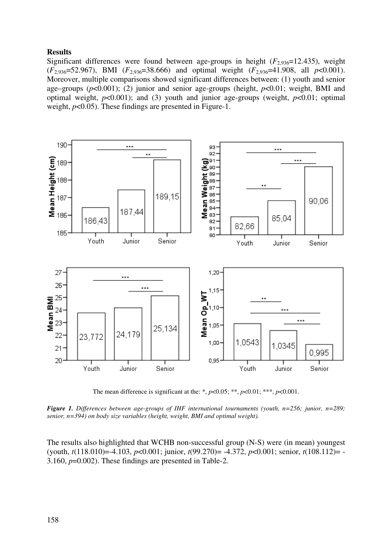
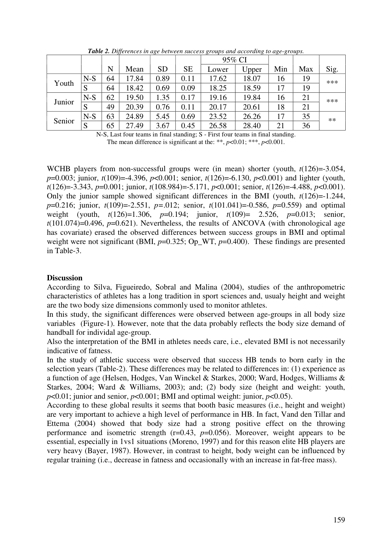
159 Table 2. Differences in age between success groups and according to age-groups. 95% CI N Mean SD SE Lower Upper Min Max Sig. N-S 64 17.84 0.89 0.11 17.62 18.07 16 19 Youth S 64 18.42 0.69 0.09 18.25 18.59 17 19 *** N-S 62 19.50 1.35 0.17 19.16 19.84 16 21 Junior S 49 20.39 0.76 0.11 20.17 20.61 18 21 *** N-S 63 24.89 5.45 0.69 23.52 26.26 17 35 Senior S 65 27.49 3.67 0.45 26.58 28.40 21 36 ** N-S, Last four teams in final standing; S First four teams in final standing. The mean difference is significant at the: **, p<0.01; ***, p<0.001. WCHB players from non-successful groups were (in mean) shorter (youth, t(126)=-3.054, p=0.003; junior, t(109)=-4.396, p<0.001; senior, t(126)=-6.130, p<0.001) and lighter (youth, t(126)=-3.343, p=0.001; junior, t(108.984)=-5.171, p<0.001; senior, t(126)=-4.488, p<0.001). Only the junior sample showed significant differences in the BMI (youth, t(126)=-1.244, p=0.216; junior, t(109)=-2.551, p=.012; senior, t(101.041)=-0.586, p=0.559) and optimal weight (youth, t(126)=1.306, p=0.194; junior, t(109)= 2.526, p=0.013; senior, t(101.074)=0.496, p=0.621). Nevertheless, the results of ANCOVA (with chronological age has covariate) erased the observed differences between success groups in BMI and optimal weight were not significant (BMI, p=0.325; Op_WT, p=0.400). These findings are presented in Table-3. Discussion According to Silva, Figueiredo, Sobral and Malina (2004), studies of the anthropometric characteristics of athletes has a long tradition in sport sciences and, usualy height and weight are the two body size dimensions commonly used to monitor athletes. In this study, the significant differences were observed between age-groups in all body size variables (Figure-1). However, note that the data probably reflects the body size demand of handball for individal age-group. Also the interpretation of the BMI in athletes needs care, i.e., elevated BMI is not necessarily indicative of fatness. In the study of athletic success were observed that success HB tends to born early in the selection years (Table-2). These differences may be related to differences in: (1) experience as a function of age (Helsen, Hodges, Van Winckel & Starkes, 2000; Ward, Hodges, Williams & Starkes, 2004; Ward & Williams, 2003); and; (2) body size (height and weight: youth, p<0.01; junior and senior, p<0.001; BMI and optimal weight: junior, p<0.05). According to these global results it seems that booth basic measures (i.e., height and weight) are very important to achieve a high level of performance in HB. In fact, Vand den Tillar and Ettema (2004) showed that body size had a strong positive effect on the throwing performance and isometric strength (r=0.43, p=0.056). Moreover, weight appears to be essential, especially in 1vs1 situations (Moreno, 1997) and for this reason elite HB players are very heavy (Bayer, 1987). However, in contrast to height, body weight can be influenced by regular training (i.e., decrease in fatness and occasionally with an increase in fat-free mass). | |
 « |  » |
|
» Zur Flash-Version des Livebooks | |