| Volltext anzeigen | |
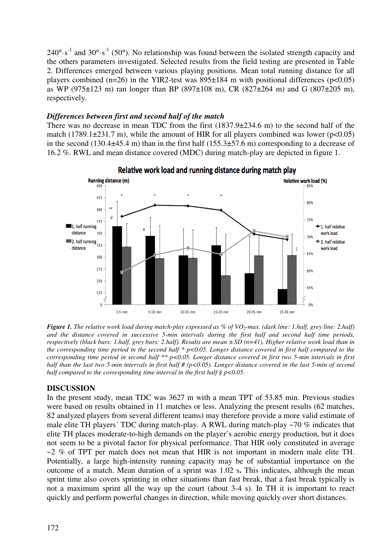
173 When successive 5-min intervals in the two halves were analyzed, the results indicated that nearly full-time players (≥ 50 min) may experience temporary muscle fatigue and impaired physical performance and recover through periods of less amount of locomotion and then tactically and physically use this to make an all-out performance in the end of the match (Figure 1). The BLC values revealed that the rate of muscle lactate production is high during an elite TH match and supports the present findings that fatigue might occur in elite TH. MDC and RWL were higher in the first 5 min of the first half than in the corresponding first 5 min of the second half. A possible reason for this may be a different preparation for the two halves. The 15 min break is probably long enough for the muscle temperature to drop, so running performance is inhibited in the initial phase of the second half. It may be advantageous for elite TH players to perform re-warm-up activities in the half time in an appropriate extent. Notably, for all types of shots examined the present speeds were higher than for Danish National Team players tested 35 years ago (Mikkelsen & Olesen, 1976), who used the same equipment and methodology as in our study. This indicates greater muscle power or better technique in elite players of today. Marked positional differences in the physical demands were observed in accordance with previous studies in DHL (Tanaka et al., 2002). The present results combined with previous study data thus suggest that running training in male elite TH should be more individually planned instead of the traditional collective way. CONCLUSIONS In conclusion, modern male elite TH is a physically demanding intermittent team sport, which during match-play places moderate-to-high demands on intermittent endurance running capacity and where the anaerobic energy turnover may be very high in brief time intervals. Although high-intensity running did not per se represent much of TPT, the ability continuously to change pace and accelerate throughout the entire match appear to be of high importance for top-level playing performance. Indications of temporary fatigue and impaired physical performance were observed during the game, reflected by the reduced amounts of HIR and decrease in RWL in the second half. Also, major individual differences in the physical demands and physical test results were demonstrated between playing positions. Consequently, modern male elite TH should comprise physical training that is adjusted to the specific playing position as well as to the players’ individual physical capacity and need to recover. In addition, an increased focus on improving high-intensity intermittent exercise capacity also seems relevant. The current findings provide valuable information about activity patterns in male elite TH players, which may be useful in the development of position-specific training regimens. _ _ _ _ _ _ _ _ _ _ _ _ LBMichalsik@health.sdu.dk | |
 « |  » |
|
» Zur Flash-Version des Livebooks | |