| Volltext anzeigen | |
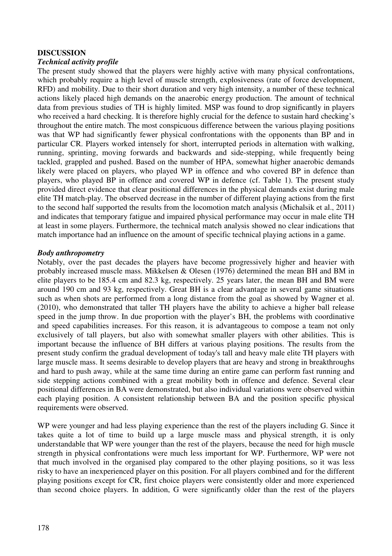
179 indicating that experience plays an important role for the performance of all kind of players, but especially for G. A crucial factor for G seems to be the acquisition of routine that comes with age, so that he gains substantial experience in how to react appropriately towards specific forms of shot from various playing positions. G in particular seems to be able to compensate for a decrease in physical shape, what may come with age, with great experience because of the highly special demands of this playing position. For all players combined in the fifth season, the majority of players were between 23 and 28 years of age. In addition, this age group contained the highest percentage of players selected first choice. This indicates that playing experience may be important in modern male elite TH, but in relation to age this may be neutralized by the importance of a sufficient physical shape to cope with the physical demands. CONCLUSIONS In conclusion, the present study demonstrates that modern male elite TH is a physically demanding and complex game which comprises numerous technical playing actions, which are conducted with short duration and high intensity intermittently throughout the entire match. The observed decline in the amount of playing actions in the second half indicated that temporary fatigue and impaired physical performance may occur at least in some players. Considerable positional differences in the physical demands were observed. Due to the nature of the game of TH as a physically demanding contact sport, body anthropometry appears to play a crucial role for playing performance at the various playing positions. PERSPECTIVES The substantial positional differences in the physical demands, which were revealed in the present study, challenge the traditional way of conducting physical training in modern TH. Consequently, differential and specific physical training in male elite TH should be implemented at the various playing positions to ensure optimal development of the physical capacity of the individual players. Such individualized training may be divided into separate exercises related to the specific requirements in defence and offence, respectively. Due to the apparent high demands in e.g. acceleration capacity, RFD, fast and hard shots, rapid side cutting manoeuvres and the high number of strength demanding physical confrontations (i.e. pushing and holding), an increased focus on strength training and also on anaerobic training aspects would seem highly relevant. Significant anthropometric development has taken place in male elite TH, since today’s players are markedly taller and heavier than players 30 years ago. Alongside the anthropometric development it is important for the players to be able to maintain or even improve functional characteristics such as acceleration capacity, ability to perform rapid changes of direction, maximum jump height and mobility as well as intermittent endurance running capacity on the playing court despite their larger and heavier body. Therefore, specific physical training targeting these performance components should be employed to optimize the functional capacity in modern male elite TH. The increased knowledge regarding the physical demands of male elite TH players is important for recommendations for the future planning and execution of physical training. Thus, the present findings may be used to design training regimens that can maximize the position-specific physical development in male elite TH players. _ _ _ _ _ _ _ _ _ _ _ _ LBMichalsik@health.sdu.dk | |
 « |  » |
|
» Zur Flash-Version des Livebooks | |