| Volltext anzeigen | |
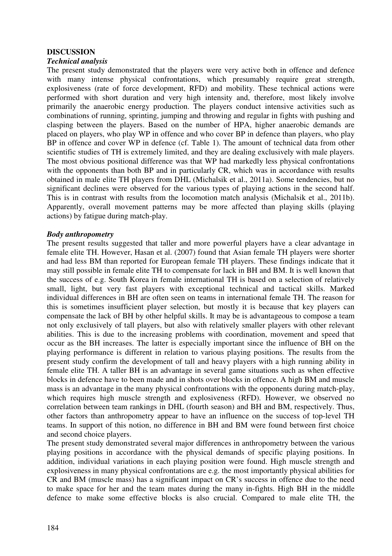
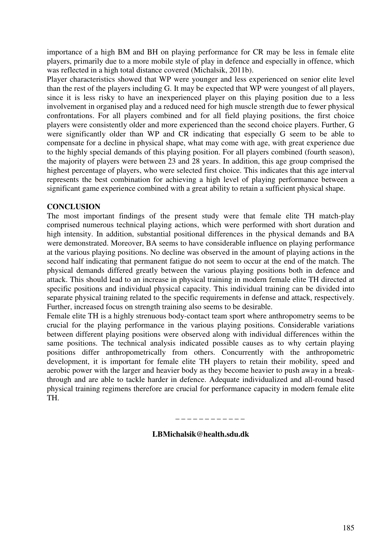
185 importance of a high BM and BH on playing performance for CR may be less in female elite players, primarily due to a more mobile style of play in defence and especially in offence, which was reflected in a high total distance covered (Michalsik, 2011b). Player characteristics showed that WP were younger and less experienced on senior elite level than the rest of the players including G. It may be expected that WP were youngest of all players, since it is less risky to have an inexperienced player on this playing position due to a less involvement in organised play and a reduced need for high muscle strength due to fewer physical confrontations. For all players combined and for all field playing positions, the first choice players were consistently older and more experienced than the second choice players. Further, G were significantly older than WP and CR indicating that especially G seem to be able to compensate for a decline in physical shape, what may come with age, with great experience due to the highly special demands of this playing position. For all players combined (fourth season), the majority of players were between 23 and 28 years. In addition, this age group comprised the highest percentage of players, who were selected first choice. This indicates that this age interval represents the best combination for achieving a high level of playing performance between a significant game experience combined with a great ability to retain a sufficient physical shape. CONCLUSION The most important findings of the present study were that female elite TH match-play comprised numerous technical playing actions, which were performed with short duration and high intensity. In addition, substantial positional differences in the physical demands and BA were demonstrated. Moreover, BA seems to have considerable influence on playing performance at the various playing positions. No decline was observed in the amount of playing actions in the second half indicating that permanent fatigue do not seem to occur at the end of the match. The physical demands differed greatly between the various playing positions both in defence and attack. This should lead to an increase in physical training in modern female elite TH directed at specific positions and individual physical capacity. This individual training can be divided into separate physical training related to the specific requirements in defense and attack, respectively. Further, increased focus on strength training also seems to be desirable. Female elite TH is a highly strenuous body-contact team sport where anthropometry seems to be crucial for the playing performance in the various playing positions. Considerable variations between different playing positions were observed along with individual differences within the same positions. The technical analysis indicated possible causes as to why certain playing positions differ anthropometrically from others. Concurrently with the anthropometric development, it is important for female elite TH players to retain their mobility, speed and aerobic power with the larger and heavier body as they become heavier to push away in a breakthrough and are able to tackle harder in defence. Adequate individualized and all-round based physical training regimens therefore are crucial for performance capacity in modern female elite TH. _ _ _ _ _ _ _ _ _ _ _ _ LBMichalsik@health.sdu.dk | |
 « |  » |
|
» Zur Flash-Version des Livebooks | |