| Volltext anzeigen | |
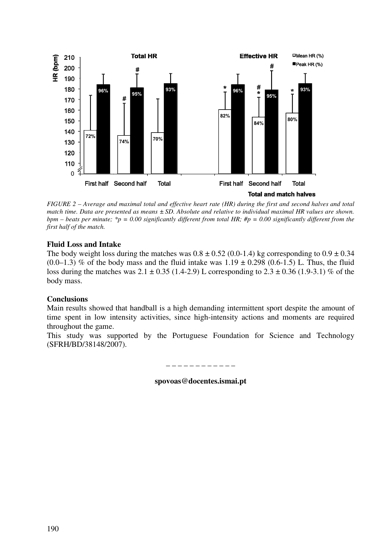
191 METABOLIC PROFILE OF ELITE TEAM HANDBALL 1Susana Cristina de Araújo PÓVOAS, 2José Manuel da Costa SOARES, 2António Natal Campos REBELO 1CIDESD, Maia Institute of Higher Education, Maia, Portugal; 2CIFID, Faculty of Sport, University of Porto, Porto, Portugal Summary This study analyzes the effect of an elite male handball game on blood and plasma metabolic markers. The anaerobic glycolytic metabolism seems to be moderately taxed during the match, although individual blood lactate values suggest that the glycolic rate is high in certain moments. Fat metabolism seems to be strongly activated, particularly during 2nd half of the game, which may likely contribute to explain the reduced exercise intensity towards the end of the match. Keywords: Team handball; metabolic markers; elite male players. Introduction Team handball is played professionally at a high competitive level in many European countries. Despite the amount of time spent in low-intensity activities, handball is considered a complex high demanding intermittent sport, since it involves frequent body contact and several other high-intensity actions to overcome opponents. Nonetheless, unlike other team sports, scientific knowledge regarding elite team handball physiological strain is scarce. Moreover, the description of metabolic demands imposed by the game is limit to blood lactate values (Delamarche et al., 1987; Michalsik, 2004). Methods A friendly match was held between two elite teams in order to analyse the effect of the match on plasma and blood biochemical markers. Even though usual proceedings and rules of official matches were assured, time-motion and heart rate (HR) analyses were conducted during this friendly match aiming to establish match intensity. Time-motion and HR data were also registered during ten official matches. Venous blood samples for measuring plasma free fatty acids (FFA), glucose, glycerol and uric acid (UA) concentrations were obtained at rest and at the end of each half of the match. Capillary blood samples for measuring blood lactate concentrations were collected at rest, at each 5-min period during the match and at the end of each half. Players were advised to maintain their normal nutritional habits and coaches were asked to continue the usual training schedule. Evaluations were carried out in the middle of competitive period where the training schedule included 6–7 training sessions per week. Subjects Biochemical, HR and time-motion data were obtained from eighteen outfield elite male players (25.2±3.25 yrs; 186.4±7.59 cm; 86.9±8.01 kg and 9.5±2.56 % fat mass) during the friendly match. The players’ HR and activity profile were also analysed during ten official matches. Participants had at least five years of experience in the top Portuguese handball competition. All subjects were previously informed about the aims of the study, the risks associated with the experiment and familiarized with all testing protocols and procedures before delivered written consent to participate. The experimental protocol was approved by the local ethics committee and followed the Declaration of Helsinki of the World Medical Association for research with humans. | |
 « |  » |
|
» Zur Flash-Version des Livebooks | |