| Volltext anzeigen | |
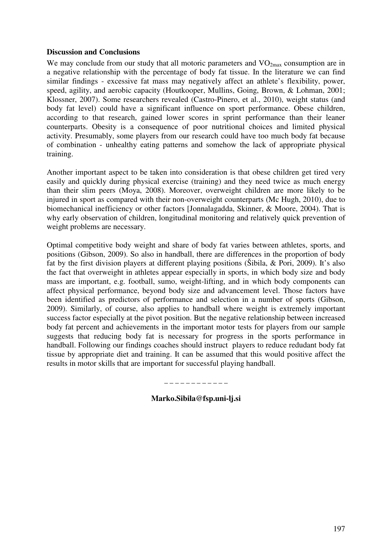
197 Discussion and Conclusions We may conclude from our study that all motoric parameters and VO2max consumption are in a negative relationship with the percentage of body fat tissue. In the literature we can find similar findings excessive fat mass may negatively affect an athlete’s flexibility, power, speed, agility, and aerobic capacity (Houtkooper, Mullins, Going, Brown, & Lohman, 2001; Klossner, 2007). Some researchers revealed (Castro-Pinero, et al., 2010), weight status (and body fat level) could have a significant influence on sport performance. Obese children, according to that research, gained lower scores in sprint performance than their leaner counterparts. Obesity is a consequence of poor nutritional choices and limited physical activity. Presumably, some players from our research could have too much body fat because of combination unhealthy eating patterns and somehow the lack of appropriate physical training. Another important aspect to be taken into consideration is that obese children get tired very easily and quickly during physical exercise (training) and they need twice as much energy than their slim peers (Moya, 2008). Moreover, overweight children are more likely to be injured in sport as compared with their non-overweight counterparts (Mc Hugh, 2010), due to biomechanical inefficiency or other factors [Jonnalagadda, Skinner, & Moore, 2004). That is why early observation of children, longitudinal monitoring and relatively quick prevention of weight problems are necessary. Optimal competitive body weight and share of body fat varies between athletes, sports, and positions (Gibson, 2009). So also in handball, there are differences in the proportion of body fat by the first division players at different playing positions (Šibila, & Pori, 2009). It’s also the fact that overweight in athletes appear especially in sports, in which body size and body mass are important, e.g. football, sumo, weight-lifting, and in which body components can affect physical performance, beyond body size and advancement level. Those factors have been identified as predictors of performance and selection in a number of sports (Gibson, 2009). Similarly, of course, also applies to handball where weight is extremely important success factor especially at the pivot position. But the negative relationship between increased body fat percent and achievements in the important motor tests for players from our sample suggests that reducing body fat is necessary for progress in the sports performance in handball. Following our findings coaches should instruct players to reduce redudant body fat tissue by appropriate diet and training. It can be assumed that this would positive affect the results in motor skills that are important for successful playing handball. _ _ _ _ _ _ _ _ _ _ _ _ Marko.Sibila@fsp.uni-lj.si | |
 « |  » |
|
» Zur Flash-Version des Livebooks | |