| Volltext anzeigen | |
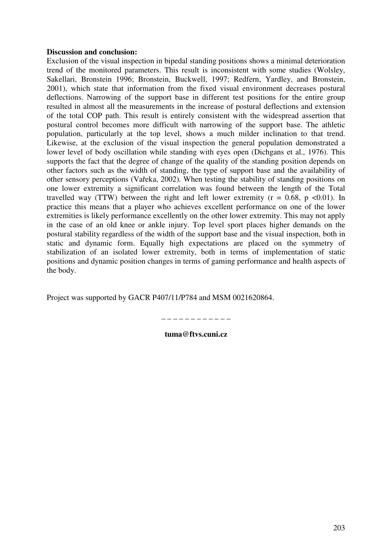
203 Discussion and conclusion: Exclusion of the visual inspection in bipedal standing positions shows a minimal deterioration trend of the monitored parameters. This result is inconsistent with some studies (Wolsley, Sakellari, Bronstein 1996; Bronstein, Buckwell, 1997; Redfern, Yardley, and Bronstein, 2001), which state that information from the fixed visual environment decreases postural deflections. Narrowing of the support base in different test positions for the entire group resulted in almost all the measurements in the increase of postural deflections and extension of the total COP path. This result is entirely consistent with the widespread assertion that postural control becomes more difficult with narrowing of the support base. The athletic population, particularly at the top level, shows a much milder inclination to that trend. Likewise, at the exclusion of the visual inspection the general population demonstrated a lower level of body oscillation while standing with eyes open (Dichgans et al., 1976). This supports the fact that the degree of change of the quality of the standing position depends on other factors such as the width of standing, the type of support base and the availability of other sensory perceptions (Vařeka, 2002). When testing the stability of standing positions on one lower extremity a significant correlation was found between the length of the Total travelled way (TTW) between the right and left lower extremity (r = 0.68, p <0.01). In practice this means that a player who achieves excellent performance on one of the lower extremities is likely performance excellently on the other lower extremity. This may not apply in the case of an old knee or ankle injury. Top level sport places higher demands on the postural stability regardless of the width of the support base and the visual inspection, both in static and dynamic form. Equally high expectations are placed on the symmetry of stabilization of an isolated lower extremity, both in terms of implementation of static positions and dynamic position changes in terms of gaming performance and health aspects of the body. Project was supported by GACR P407/11/P784 and MSM 0021620864. _ _ _ _ _ _ _ _ _ _ _ _ tuma@ftvs.cuni.cz | |
 « |  » |
|
» Zur Flash-Version des Livebooks | |