| Volltext anzeigen | |
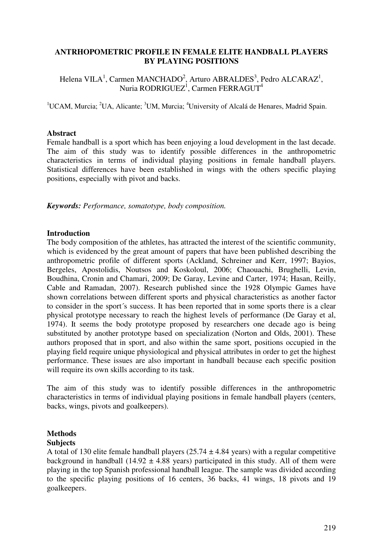
219 ANTRHOPOMETRIC PROFILE IN FEMALE ELITE HANDBALL PLAYERS BY PLAYING POSITIONS Helena VILA1, Carmen MANCHADO2, Arturo ABRALDES3, Pedro ALCARAZ1, Nuria RODRIGUEZ1, Carmen FERRAGUT4 1UCAM, Murcia; 2UA, Alicante; 3UM, Murcia; 4University of Alcalá de Henares, Madrid Spain. Abstract Female handball is a sport which has been enjoying a loud development in the last decade. The aim of this study was to identify possible differences in the anthropometric characteristics in terms of individual playing positions in female handball players. Statistical differences have been established in wings with the others specific playing positions, especially with pivot and backs. Keywords: Performance, somatotype, body composition. Introduction The body composition of the athletes, has attracted the interest of the scientific community, which is evidenced by the great amount of papers that have been published describing the anthropometric profile of different sports (Ackland, Schreiner and Kerr, 1997; Bayios, Bergeles, Apostolidis, Noutsos and Koskoloul, 2006; Chaouachi, Brughelli, Levin, Boudhina, Cronin and Chamari, 2009; De Garay, Levine and Carter, 1974; Hasan, Reilly, Cable and Ramadan, 2007). Research published since the 1928 Olympic Games have shown correlations between different sports and physical characteristics as another factor to consider in the sport´s success. It has been reported that in some sports there is a clear physical prototype necessary to reach the highest levels of performance (De Garay et al, 1974). It seems the body prototype proposed by researchers one decade ago is being substituted by another prototype based on specialization (Norton and Olds, 2001). These authors proposed that in sport, and also within the same sport, positions occupied in the playing field require unique physiological and physical attributes in order to get the highest performance. These issues are also important in handball because each specific position will require its own skills according to its task. The aim of this study was to identify possible differences in the anthropometric characteristics in terms of individual playing positions in female handball players (centers, backs, wings, pivots and goalkeepers). Methods Subjects A total of 130 elite female handball players (25.74 ± 4.84 years) with a regular competitive background in handball (14.92 ± 4.88 years) participated in this study. All of them were playing in the top Spanish professional handball league. The sample was divided according to the specific playing positions of 16 centers, 36 backs, 41 wings, 18 pivots and 19 goalkeepers. | |
 « |  » |
|
» Zur Flash-Version des Livebooks | |