| Volltext anzeigen | |
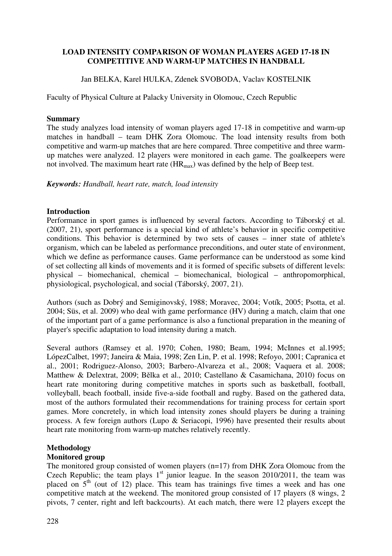
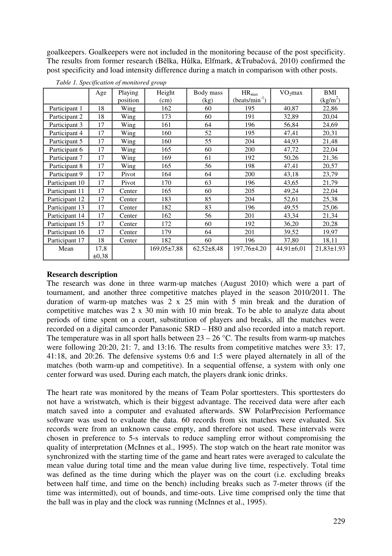
229 goalkeepers. Goalkeepers were not included in the monitoring because of the post specificity. The results from former research (Bělka, Hůlka, Elfmark, &Trubačová, 2010) confirmed the post specificity and load intensity difference during a match in comparison with other posts. Table 1. Specification of monitored group Age Playing position Height (cm) Body mass (kg) HRmax (beats/min-1) VO2max BMI (kg/m2) Participant 1 18 Wing 162 60 195 40,87 22,86 Participant 2 18 Wing 173 60 191 32,89 20,04 Participant 3 17 Wing 161 64 196 56,84 24,69 Participant 4 17 Wing 160 52 195 47,41 20,31 Participant 5 17 Wing 160 55 204 44,93 21,48 Participant 6 17 Wing 165 60 200 47,72 22,04 Participant 7 17 Wing 169 61 192 50,26 21,36 Participant 8 17 Wing 165 56 198 47,41 20,57 Participant 9 17 Pivot 164 64 200 43,18 23,79 Participant 10 17 Pivot 170 63 196 43,65 21,79 Participant 11 17 Center 165 60 205 49,24 22,04 Participant 12 17 Center 183 85 204 52,61 25,38 Participant 13 17 Center 182 83 196 49,55 25,06 Participant 14 17 Center 162 56 201 43,34 21,34 Participant 15 17 Center 172 60 192 36,20 20,28 Participant 16 17 Center 179 64 201 39,52 19,97 Participant 17 18 Center 182 60 196 37,80 18,11 Mean 17,8 ±0,38 169,05±7,88 62,52±8,48 197,76±4,20 44,91±6,01 21,83±1,93 Research description The research was done in three warm-up matches (August 2010) which were a part of tournament, and another three competitive matches played in the season 2010/2011. The duration of warm-up matches was 2 x 25 min with 5 min break and the duration of competitive matches was 2 x 30 min with 10 min break. To be able to analyze data about periods of time spent on a court, substitution of players and breaks, all the matches were recorded on a digital camcorder Panasonic SRD – H80 and also recorded into a match report. The temperature was in all sport halls between 23 – 26 °C. The results from warm-up matches were following 20:20, 21: 7, and 13:16. The results from competitive matches were 33: 17, 41:18, and 20:26. The defensive systems 0:6 and 1:5 were played alternately in all of the matches (both warm-up and competitive). In a sequential offense, a system with only one center forward was used. During each match, the players drank ionic drinks. The heart rate was monitored by the means of Team Polar sporttesters. This sporttesters do not have a wristwatch, which is their biggest advantage. The received data were after each match saved into a computer and evaluated afterwards. SW PolarPrecision Performance software was used to evaluate the data. 60 records from six matches were evaluated. Six records were from an unknown cause empty, and therefore not used. These intervals were chosen in preference to 5-s intervals to reduce sampling error without compromising the quality of interpretation (McInnes et al., 1995). The stop watch on the heart rate monitor was synchronized with the starting time of the game and heart rates were averaged to calculate the mean value during total time and the mean value during live time, respectively. Total time was defined as the time during which the player was on the court (i.e. excluding breaks between half time, and time on the bench) including breaks such as 7-meter throws (if the time was intermitted), out of bounds, and time-outs. Live time comprised only the time that the ball was in play and the clock was running (McInnes et al., 1995). | |
 « |  » |
|
» Zur Flash-Version des Livebooks | |