| Volltext anzeigen | |
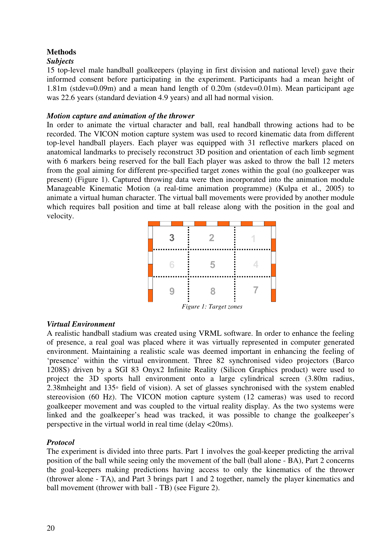
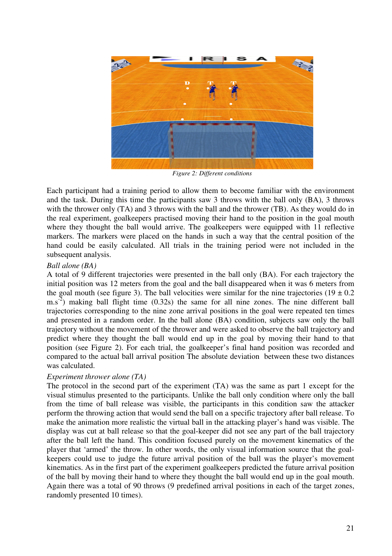
21 Figure 2: Different conditions Each participant had a training period to allow them to become familiar with the environment and the task. During this time the participants saw 3 throws with the ball only (BA), 3 throws with the thrower only (TA) and 3 throws with the ball and the thrower (TB). As they would do in the real experiment, goalkeepers practised moving their hand to the position in the goal mouth where they thought the ball would arrive. The goalkeepers were equipped with 11 reflective markers. The markers were placed on the hands in such a way that the central position of the hand could be easily calculated. All trials in the training period were not included in the subsequent analysis. Ball alone (BA) A total of 9 different trajectories were presented in the ball only (BA). For each trajectory the initial position was 12 meters from the goal and the ball disappeared when it was 6 meters from the goal mouth (see figure 3). The ball velocities were similar for the nine trajectories (19 ± 0.2 m.s-2) making ball flight time (0.32s) the same for all nine zones. The nine different ball trajectories corresponding to the nine zone arrival positions in the goal were repeated ten times and presented in a random order. In the ball alone (BA) condition, subjects saw only the ball trajectory without the movement of the thrower and were asked to observe the ball trajectory and predict where they thought the ball would end up in the goal by moving their hand to that position (see Figure 2). For each trial, the goalkeeper’s final hand position was recorded and compared to the actual ball arrival position The absolute deviation between these two distances was calculated. Experiment thrower alone (TA) The protocol in the second part of the experiment (TA) was the same as part 1 except for the visual stimulus presented to the participants. Unlike the ball only condition where only the ball from the time of ball release was visible, the participants in this condition saw the attacker perform the throwing action that would send the ball on a specific trajectory after ball release. To make the animation more realistic the virtual ball in the attacking player’s hand was visible. The display was cut at ball release so that the goal-keeper did not see any part of the ball trajectory after the ball left the hand. This condition focused purely on the movement kinematics of the player that ‘armed’ the throw. In other words, the only visual information source that the goalkeepers could use to judge the future arrival position of the ball was the player’s movement kinematics. As in the first part of the experiment goalkeepers predicted the future arrival position of the ball by moving their hand to where they thought the ball would end up in the goal mouth. Again there was a total of 90 throws (9 predefined arrival positions in each of the target zones, randomly presented 10 times). B T T | |
 « |  » |
|
» Zur Flash-Version des Livebooks | |