| Volltext anzeigen | |
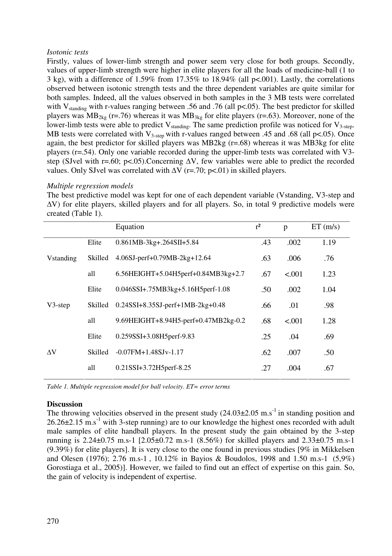
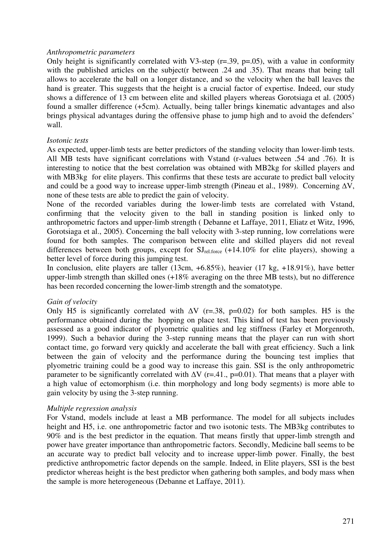
271 Anthropometric parameters Only height is significantly correlated with V3-step (r=.39, p=.05), with a value in conformity with the published articles on the subject(r between .24 and .35). That means that being tall allows to accelerate the ball on a longer distance, and so the velocity when the ball leaves the hand is greater. This suggests that the height is a crucial factor of expertise. Indeed, our study shows a difference of 13 cm between elite and skilled players whereas Gorotsiaga et al. (2005) found a smaller difference (+5cm). Actually, being taller brings kinematic advantages and also brings physical advantages during the offensive phase to jump high and to avoid the defenders’ wall. Isotonic tests As expected, upper-limb tests are better predictors of the standing velocity than lower-limb tests. All MB tests have significant correlations with Vstand (r-values between .54 and .76). It is interesting to notice that the best correlation was obtained with MB2kg for skilled players and with MB3kg for elite players. This confirms that these tests are accurate to predict ball velocity and could be a good way to increase upper-limb strength (Pineau et al., 1989). Concerning ∆V, none of these tests are able to predict the gain of velocity. None of the recorded variables during the lower-limb tests are correlated with Vstand, confirming that the velocity given to the ball in standing position is linked only to anthropometric factors and upper-limb strength ( Debanne et Laffaye, 2011, Eliatz et Witz, 1996, Gorotsiaga et al., 2005). Concerning the ball velocity with 3-step running, low correlations were found for both samples. The comparison between elite and skilled players did not reveal differences between both groups, except for SJrel.force (+14.10% for elite players), showing a better level of force during this jumping test. In conclusion, elite players are taller (13cm, +6.85%), heavier (17 kg, +18.91%), have better upper-limb strength than skilled ones (+18% averaging on the three MB tests), but no difference has been recorded concerning the lower-limb strength and the somatotype. Gain of velocity Only H5 is significantly correlated with V (r=.38, p=0.02) for both samples. H5 is the performance obtained during the hopping on place test. This kind of test has been previously assessed as a good indicator of plyometric qualities and leg stiffness (Farley et Morgenroth, 1999). Such a behavior during the 3-step running means that the player can run with short contact time, go forward very quickly and accelerate the ball with great efficiency. Such a link between the gain of velocity and the performance during the bouncing test implies that plyometric training could be a good way to increase this gain. SSI is the only anthropometric parameter to be significantly correlated with V (r=.41., p=0.01). That means that a player with a high value of ectomorphism (i.e. thin morphology and long body segments) is more able to gain velocity by using the 3-step running. Multiple regression analysis For Vstand, models include at least a MB performance. The model for all subjects includes height and H5, i.e. one anthropometric factor and two isotonic tests. The MB3kg contributes to 90% and is the best predictor in the equation. That means firstly that upper-limb strength and power have greater importance than anthropometric factors. Secondly, Medicine ball seems to be an accurate way to predict ball velocity and to increase upper-limb power. Finally, the best predictive anthropometric factor depends on the sample. Indeed, in Elite players, SSI is the best predictor whereas height is the best predictor when gathering both samples, and body mass when the sample is more heterogeneous (Debanne et Laffaye, 2011). | |
 « |  » |
|
» Zur Flash-Version des Livebooks | |