| Volltext anzeigen | |
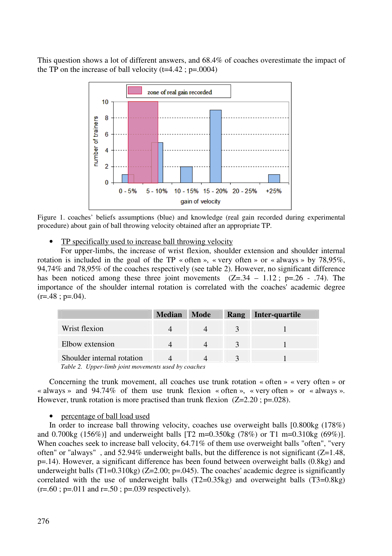
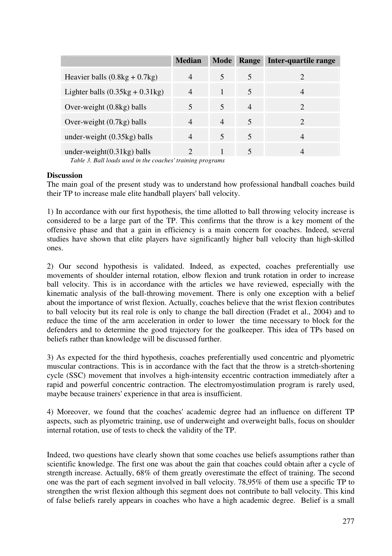
277 Median Mode Range Inter-quartile range Heavier balls (0.8kg + 0.7kg) 4 5 5 2 Lighter balls (0.35kg + 0.31kg) 4 1 5 4 Over-weight (0.8kg) balls 5 5 4 2 Over-weight (0.7kg) balls 4 4 5 2 under-weight (0.35kg) balls 4 5 5 4 under-weight(0.31kg) balls 2 1 5 4 Table 3. Ball loads used in the coaches' training programs Discussion The main goal of the present study was to understand how professional handball coaches build their TP to increase male elite handball players' ball velocity. 1) In accordance with our first hypothesis, the time allotted to ball throwing velocity increase is considered to be a large part of the TP. This confirms that the throw is a key moment of the offensive phase and that a gain in efficiency is a main concern for coaches. Indeed, several studies have shown that elite players have significantly higher ball velocity than high-skilled ones. 2) Our second hypothesis is validated. Indeed, as expected, coaches preferentially use movements of shoulder internal rotation, elbow flexion and trunk rotation in order to increase ball velocity. This is in accordance with the articles we have reviewed, especially with the kinematic analysis of the ball-throwing movement. There is only one exception with a belief about the importance of wrist flexion. Actually, coaches believe that the wrist flexion contributes to ball velocity but its real role is only to change the ball direction (Fradet et al., 2004) and to reduce the time of the arm acceleration in order to lower the time necessary to block for the defenders and to determine the good trajectory for the goalkeeper. This idea of TPs based on beliefs rather than knowledge will be discussed further. 3) As expected for the third hypothesis, coaches preferentially used concentric and plyometric muscular contractions. This is in accordance with the fact that the throw is a stretch-shortening cycle (SSC) movement that involves a high-intensity eccentric contraction immediately after a rapid and powerful concentric contraction. The electromyostimulation program is rarely used, maybe because trainers' experience in that area is insufficient. 4) Moreover, we found that the coaches' academic degree had an influence on different TP aspects, such as plyometric training, use of underweight and overweight balls, focus on shoulder internal rotation, use of tests to check the validity of the TP. Indeed, two questions have clearly shown that some coaches use beliefs assumptions rather than scientific knowledge. The first one was about the gain that coaches could obtain after a cycle of strength increase. Actually, 68% of them greatly overestimate the effect of training. The second one was the part of each segment involved in ball velocity. 78,95% of them use a specific TP to strengthen the wrist flexion although this segment does not contribute to ball velocity. This kind of false beliefs rarely appears in coaches who have a high academic degree. Belief is a small | |
 « |  » |
|
» Zur Flash-Version des Livebooks | |