| Volltext anzeigen | |
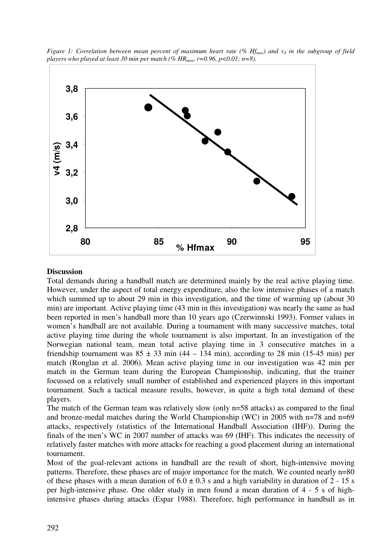
293 other game sports includes the capacity to compensate for repetitive, short, and high-intensive movements without fatigue for the duration of a whole match. This requires a fast creatinephosphate resynthesis (Glaister 2005). Moreover, the somewhat longer lasting intensive phases require a fast and efficient ATP resynthesis from the glycolic energy pathway, which is accompanied by a physiologically relevant lactate production. In earlier years, studies reported lactate concentrations in handball players of 8 mmol/l (Haralambie et al. 1981). The higher the aerobic capacity of a player, the faster and stronger lactate elimination occurs (Billat et al. 2003). Acidosis of the organism including negative effects on performance (e.g. reduced muscular performance, reduced concentration, a possibly higher injury risk etc.) is probably reduced even during high intensive phases in those players who have a better development of aerobic performance (Platen 1989). Heart rate during a match might be used with some restrictions as indicator of the intensity of intermittent exercises like sport games. Oxygen consumption and real individual energy demands might be estimated using mean heart rates, when individual HR behaviour and oxygen uptake are known (Achten et al. 2003, Lothian et al. 1995, Miyamura et al. 1996). This is approximately also true for intermittent exercises (Lothian et al. 1995). Only few data on heart rates during handball matches are available in the literature. In male players mean heart rate during a whole match was reported to be between 75 and 80 % HRmax (Chirosa et al. 1999). In female field hockey, players HRs were between 82 and 87 % HRmax (Sunderland et al. 2006). An older investigation in women’s soccer showed HR values between 89 and 91% HRmax (Brewer et al. 1994). Altogether, mean percent HRmax values did not differ remarkably between the different sport games, although muscular energy supply clearly differs between the sport-specific moving demands like intermittent, shorter or longer sprinting (Glaister 2005, Spencer et al. 2005). To get more insight into the relevant metabolic reactions, further studies combining the analysis of movement patterns and individual physiological reactions including heart rates in the different sport games are necessary. In our investigation, intra-individual variation in %HRmax between the different games was with only few exceptions much lower as compared to inter-individual variation in %HRmax. Intraindividual variation in %HRmax is probably mainly due to opponentor tactic-depending adaptations of individual moving behaviours. In contrast, inter-individual variation in %HRmax is probably mainly due to the underlying aerobic performance of each single player, when the number of players who actively play is quite small and all players participate in handball-specific team-tactical movements like in this investigation. This is strongly supported by our finding of a highly significant negative correlation between v4 and %HRmax. Therefore, individual cardiopulmonary demands during handball matches are the lower, the better developed aerobic performance of each individual player is. Although no data on the association between further handball-relevant performance characteristics like goal effectiveness and rate of technical mistakes are available so far, it is very probable that these correlations to aerobic performance also exists. The more tired a player gets, the higher the quote of technical mistakes of this player (Platen 1989). Conclusion Cardiopulmonary demands were very high in all players in all matches. We could demonstrate for the first time in team sports that individual load during a highly demanding tournament was the higher the worse developed basic endurance capacity (v4) was. This is a strong indicator for the necessity of the development of a high aerobic capacity in international female top level handball. _ _ _ _ _ _ _ _ _ _ _ _ Petra.Platen@ruhr-uni-bochum.de | |
 « |  » |
|
» Zur Flash-Version des Livebooks | |