| Volltext anzeigen | |
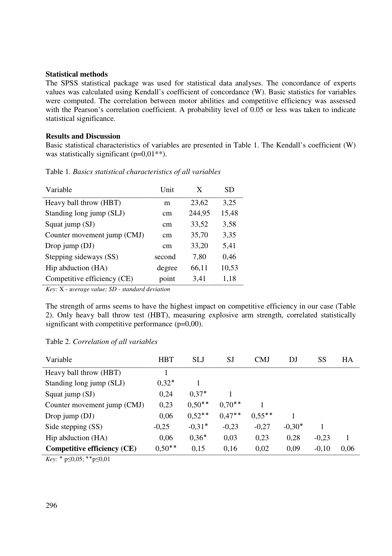
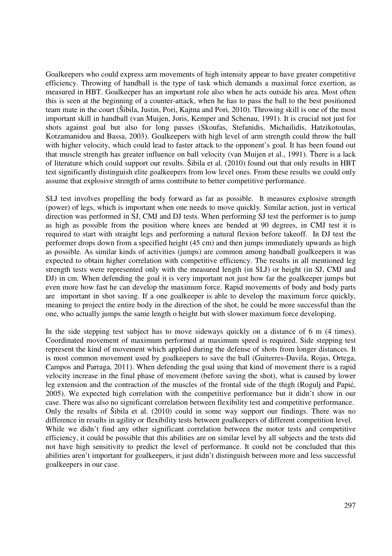
297 Goalkeepers who could express arm movements of high intensity appear to have greater competitive efficiency. Throwing of handball is the type of task which demands a maximal force exertion, as measured in HBT. Goalkeeper has an important role also when he acts outside his area. Most often this is seen at the beginning of a counter-attack, when he has to pass the ball to the best positioned team mate in the court (Šibila, Justin, Pori, Kajtna and Pori, 2010). Throwing skill is one of the most important skill in handball (van Muijen, Joris, Kemper and Schenau, 1991). It is crucial not just for shots against goal but also for long passes (Skoufas, Stefanidis, Michailidis, Hatzikotoulas, Kotzamanidou and Bassa, 2003). Goalkeepers with high level of arm strength could throw the ball with higher velocity, which could lead to faster attack to the opponent’s goal. It has been found out that muscle strength has greater influence on ball velocity (van Muijen et al., 1991). There is a lack of literature which could support our results. Šibila et al. (2010) found out that only results in HBT test significantly distinguish elite goalkeepers from low level ones. From these results we could only assume that explosive strength of arms contribute to better competitive performance. SLJ test involves propelling the body forward as far as possible. It measures explosive strength (power) of legs, which is important when one needs to move quickly. Similar action, just in vertical direction was performed in SJ, CMJ and DJ tests. When performing SJ test the performer is to jump as high as possible from the position where knees are bended at 90 degrees, in CMJ test it is required to start with straight legs and performing a natural flexion before takeoff. In DJ test the performer drops down from a specified height (45 cm) and then jumps immediately upwards as high as possible. As similar kinds of activities (jumps) are common among handball goalkeepers it was expected to obtain higher correlation with competitive efficiency. The results in all mentioned leg strength tests were represented only with the measured length (in SLJ) or height (in SJ, CMJ and DJ) in cm. When defending the goal it is very important not just how far the goalkeeper jumps but even more how fast he can develop the maximum force. Rapid movements of body and body parts are important in shot saving. If a one goalkeeper is able to develop the maximum force quickly, meaning to project the entire body in the direction of the shot, he could be more successful than the one, who actually jumps the same length o height but with slower maximum force developing. In the side stepping test subject has to move sideways quickly on a distance of 6 m (4 times). Coordinated movement of maximum performed at maximum speed is required. Side stepping test represent the kind of movement which applied during the defense of shots from longer distances. It is most common movement used by goalkeepers to save the ball (Guiterres-Davila, Rojas, Ortega, Campos and Parraga, 2011). When defending the goal using that kind of movement there is a rapid velocity increase in the final phase of movement (before saving the shot), what is caused by lower leg extension and the contraction of the muscles of the frontal side of the thigh (Rogulj and Papić, 2005). We expected high correlation with the competitive performance but it didn’t show in our case. There was also no significant correlation between flexibility test and competitive performance. Only the results of Šibila et al. (2010) could in some way support our findings. There was no difference in results in agility or flexibility tests between goalkeepers of different competition level. While we didn’t find any other significant correlation between the motor tests and competitive efficiency, it could be possible that this abilities are on similar level by all subjects and the tests did not have high sensitivity to predict the level of performance. It could not be concluded that this abilities aren’t important for goalkeepers, it just didn’t distinguish between more and less successful goalkeepers in our case. | |
 « |  » |
|
» Zur Flash-Version des Livebooks | |