| Volltext anzeigen | |
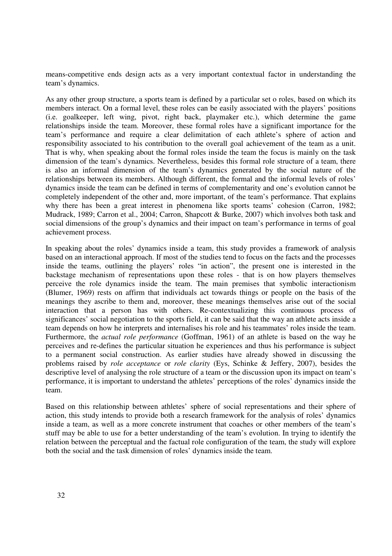
33 Methodology The research perspective upon the roles’ dynamics inside sports teams is based on a case study on a professional handball team from the Second League of the Romanian Feminine Championship. Moreover, the methodological design of the study rests on a mix-method approach that combines a sociometric analysis of group members’ relationships, on both factual and perceptual level, with the observation method applied during training and competition contexts and in-depth interviews with the team’s coach. The present research has a longitudinal dimension, as the study was conducted over a period of two competition seasons (2008-2009 and 2009-2010), in two waves. If we were to make a brief remark regarding the contextual aspects of the team’s evolution, for a better understanding of the roles’ dynamics inside the team, it is important to say that these were also the first two years of this team’s existence. So, using Tuckman’s model of small-group development (Tuckman & Jensen, 1977) and adding to it the specificity of sports teams that is the cyclicity of teams’ membership from a competition season to another – the case study includes the storming and norming stages of the team in its first year of existence and competition activity, but also the first stages from its second competition year. As for the sociometric test, in order to be able to analyze the relationship between the perceptual and the factual dimensions of the roles’ dynamics, the design of the research instrument was based on a two axis crossing (Figure 1): the perceptual-factual one and the attraction-rejection one. Figure 1. Design of the sociometric test Results and discussion There are three main dimensions that we can refer to in discussing the results of the research: the evaluation of the role’s distribution on task and social level, the visibility of roles inside the team and the degree of athletes’ accuracy in evaluating their own position inside the team. This balance between the two complementary perspectives: the manner in which each athlete perceives that he is seen by his colleagues and the way he himself evaluates other members’ positions inside the team is a re-contextualised form of the principles behind the classical looking glass self model (Cooley, 1902). So, what this study is focus on is the comparison between alternative perceptions of team’s members on their own role and on the roles of their teammates, trying to identify convergent and divergent perspectives which, in fact, constitute the real basis of the roles’ dynamics inside the team as a social construct per se. On a descriptive level of analysis, the results of the sociometric test showed a quite different situation between the task and the social dimension in terms of the team’s structure of roles on these criteria. While the task roles’ structure is a centralised one, on both the positive (attraction), as well as the negative (rejection) levels of professional recognition, the team’s sociogram reveals a high level of fragmentation and the lack of a relational leader inside the team. As the team’s coach pointed out when discussing the climate inside the team: “What this team lacks of is the presence of a hen that could gather its chickens around it.” However, these micro-groups that emerge on the social dimension of the team’s dynamics are strongly correlated with the previous team’s | |
 « |  » |
|
» Zur Flash-Version des Livebooks | |