| Volltext anzeigen | |
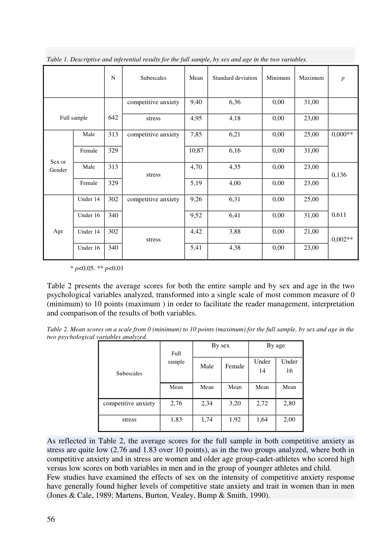
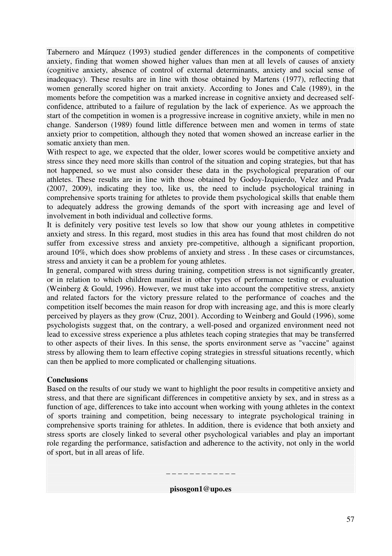
57 Tabernero and Márquez (1993) studied gender differences in the components of competitive anxiety, finding that women showed higher values than men at all levels of causes of anxiety (cognitive anxiety, absence of control of external determinants, anxiety and social sense of inadequacy). These results are in line with those obtained by Martens (1977), reflecting that women generally scored higher on trait anxiety. According to Jones and Cale (1989), in the moments before the competition was a marked increase in cognitive anxiety and decreased selfconfidence, attributed to a failure of regulation by the lack of experience. As we approach the start of the competition in women is a progressive increase in cognitive anxiety, while in men no change. Sanderson (1989) found little difference between men and women in terms of state anxiety prior to competition, although they noted that women showed an increase earlier in the somatic anxiety than men. With respect to age, we expected that the older, lower scores would be competitive anxiety and stress since they need more skills than control of the situation and coping strategies, but that has not happened, so we must also consider these data in the psychological preparation of our athletes. These results are in line with those obtained by Godoy-Izquierdo, Velez and Prada (2007, 2009), indicating they too, like us, the need to include psychological training in comprehensive sports training for athletes to provide them psychological skills that enable them to adequately address the growing demands of the sport with increasing age and level of involvement in both individual and collective forms. It is definitely very positive test levels so low that show our young athletes in competitive anxiety and stress. In this regard, most studies in this area has found that most children do not suffer from excessive stress and anxiety pre-competitive, although a significant proportion, around 10%, which does show problems of anxiety and stress . In these cases or circumstances, stress and anxiety it can be a problem for young athletes. In general, compared with stress during training, competition stress is not significantly greater, or in relation to which children manifest in other types of performance testing or evaluation (Weinberg & Gould, 1996). However, we must take into account the competitive stress, anxiety and related factors for the victory pressure related to the performance of coaches and the competition itself becomes the main reason for drop with increasing age, and this is more clearly perceived by players as they grow (Cruz, 2001). According to Weinberg and Gould (1996), some psychologists suggest that, on the contrary, a well-posed and organized environment need not lead to excessive stress experience a plus athletes teach coping strategies that may be transferred to other aspects of their lives. In this sense, the sports environment serve as "vaccine" against stress by allowing them to learn effective coping strategies in stressful situations recently, which can then be applied to more complicated or challenging situations. Conclusions Based on the results of our study we want to highlight the poor results in competitive anxiety and stress, and that there are significant differences in competitive anxiety by sex, and in stress as a function of age, differences to take into account when working with young athletes in the context of sports training and competition, being necessary to integrate psychological training in comprehensive sports training for athletes. In addition, there is evidence that both anxiety and stress sports are closely linked to several other psychological variables and play an important role regarding the performance, satisfaction and adherence to the activity, not only in the world of sport, but in all areas of life. _ _ _ _ _ _ _ _ _ _ _ _ pisosgon1@upo.es | |
 « |  » |
|
» Zur Flash-Version des Livebooks | |