| Volltext anzeigen | |
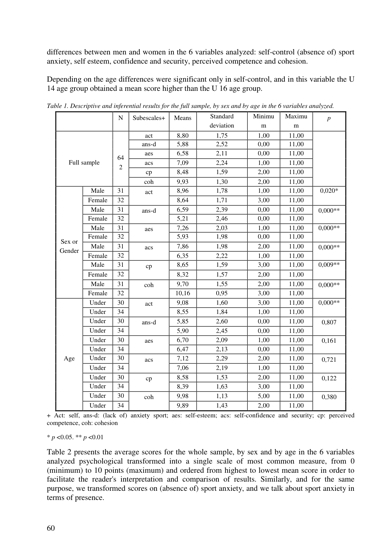
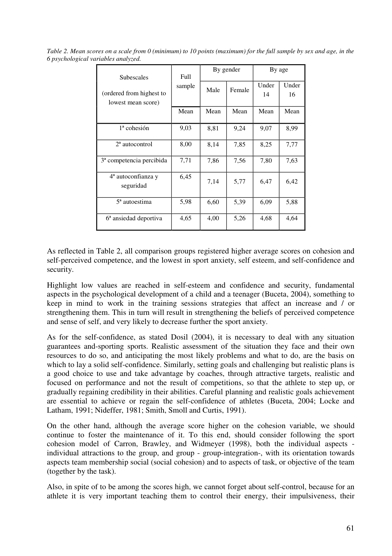
61 Table 2. Mean scores on a scale from 0 (minimum) to 10 points (maximum) for the full sample by sex and age, in the 6 psychological variables analyzed. By gender By age Full sample Male Female Under 14 Under 16 Subescales (ordered from highest to lowest mean score) Mean Mean Mean Mean Mean 1ª cohesión 9,03 8,81 9,24 9,07 8,99 2ª autocontrol 8,00 8,14 7,85 8,25 7,77 3ª competencia percibida 7,71 7,86 7,56 7,80 7,63 4ª autoconfianza y seguridad 6,45 7,14 5,77 6,47 6,42 5ª autoestima 5,98 6,60 5,39 6,09 5,88 6ª ansiedad deportiva 4,65 4,00 5,26 4,68 4,64 As reflected in Table 2, all comparison groups registered higher average scores on cohesion and self-perceived competence, and the lowest in sport anxiety, self esteem, and self-confidence and security. Highlight low values are reached in self-esteem and confidence and security, fundamental aspects in the psychological development of a child and a teenager (Buceta, 2004), something to keep in mind to work in the training sessions strategies that affect an increase and / or strengthening them. This in turn will result in strengthening the beliefs of perceived competence and sense of self, and very likely to decrease further the sport anxiety. As for the self-confidence, as stated Dosil (2004), it is necessary to deal with any situation guarantees and-sporting sports. Realistic assessment of the situation they face and their own resources to do so, and anticipating the most likely problems and what to do, are the basis on which to lay a solid self-confidence. Similarly, setting goals and challenging but realistic plans is a good choice to use and take advantage by coaches, through attractive targets, realistic and focused on performance and not the result of competitions, so that the athlete to step up, or gradually regaining credibility in their abilities. Careful planning and realistic goals achievement are essential to achieve or regain the self-confidence of athletes (Buceta, 2004; Locke and Latham, 1991; Nideffer, 1981; Smith, Smoll and Curtis, 1991). On the other hand, although the average score higher on the cohesion variable, we should continue to foster the maintenance of it. To this end, should consider following the sport cohesion model of Carron, Brawley, and Widmeyer (1998), both the individual aspects individual attractions to the group, and group group-integration-, with its orientation towards aspects team membership social (social cohesion) and to aspects of task, or objective of the team (together by the task). Also, in spite of to be among the scores high, we cannot forget about self-control, because for an athlete it is very important teaching them to control their energy, their impulsiveness, their | |
 « |  » |
|
» Zur Flash-Version des Livebooks | |