| Volltext anzeigen | |
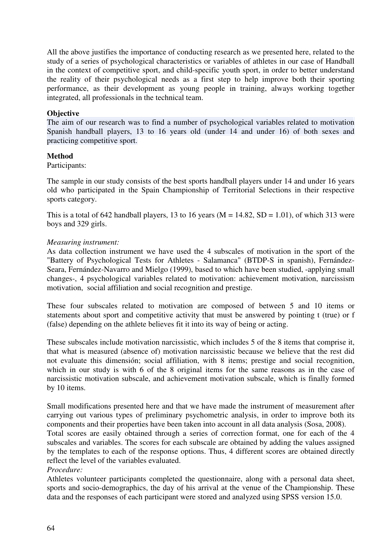
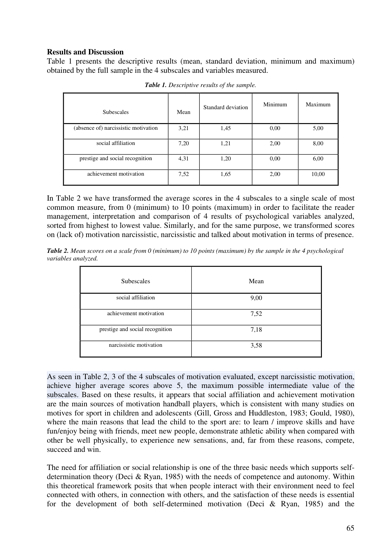
65 Results and Discussion Table 1 presents the descriptive results (mean, standard deviation, minimum and maximum) obtained by the full sample in the 4 subscales and variables measured. Table 1. Descriptive results of the sample. Subescales Mean Standard deviation Minimum Maximum (absence of) narcissistic motivation 3,21 1,45 0,00 5,00 social affiliation 7,20 1,21 2,00 8,00 prestige and social recognition 4,31 1,20 0,00 6,00 achievement motivation 7,52 1,65 2,00 10,00 In Table 2 we have transformed the average scores in the 4 subscales to a single scale of most common measure, from 0 (minimum) to 10 points (maximum) in order to facilitate the reader management, interpretation and comparison of 4 results of psychological variables analyzed, sorted from highest to lowest value. Similarly, and for the same purpose, we transformed scores on (lack of) motivation narcissistic, narcissistic and talked about motivation in terms of presence. Table 2. Mean scores on a scale from 0 (minimum) to 10 points (maximum) by the sample in the 4 psychological variables analyzed. Subescales Mean social affiliation 9,00 achievement motivation 7,52 prestige and social recognition 7,18 narcissistic motivation 3,58 As seen in Table 2, 3 of the 4 subscales of motivation evaluated, except narcissistic motivation, achieve higher average scores above 5, the maximum possible intermediate value of the subscales. Based on these results, it appears that social affiliation and achievement motivation are the main sources of motivation handball players, which is consistent with many studies on motives for sport in children and adolescents (Gill, Gross and Huddleston, 1983; Gould, 1980), where the main reasons that lead the child to the sport are: to learn / improve skills and have fun/enjoy being with friends, meet new people, demonstrate athletic ability when compared with other be well physically, to experience new sensations, and, far from these reasons, compete, succeed and win. The need for affiliation or social relationship is one of the three basic needs which supports selfdetermination theory (Deci & Ryan, 1985) with the needs of competence and autonomy. Within this theoretical framework posits that when people interact with their environment need to feel connected with others, in connection with others, and the satisfaction of these needs is essential for the development of both self-determined motivation (Deci & Ryan, 1985) and the | |
 « |  » |
|
» Zur Flash-Version des Livebooks | |