| Volltext anzeigen | |
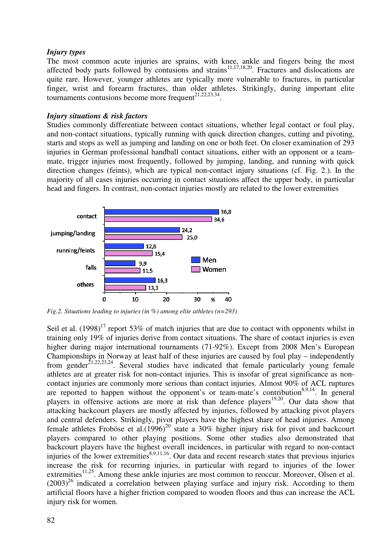
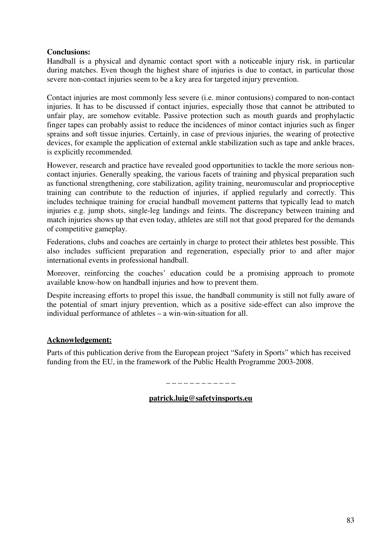
83 Conclusions: Handball is a physical and dynamic contact sport with a noticeable injury risk, in particular during matches. Even though the highest share of injuries is due to contact, in particular those severe non-contact injuries seem to be a key area for targeted injury prevention. Contact injuries are most commonly less severe (i.e. minor contusions) compared to non-contact injuries. It has to be discussed if contact injuries, especially those that cannot be attributed to unfair play, are somehow evitable. Passive protection such as mouth guards and prophylactic finger tapes can probably assist to reduce the incidences of minor contact injuries such as finger sprains and soft tissue injuries. Certainly, in case of previous injuries, the wearing of protective devices, for example the application of external ankle stabilization such as tape and ankle braces, is explicitly recommended. However, research and practice have revealed good opportunities to tackle the more serious noncontact injuries. Generally speaking, the various facets of training and physical preparation such as functional strengthening, core stabilization, agility training, neuromuscular and proprioceptive training can contribute to the reduction of injuries, if applied regularly and correctly. This includes technique training for crucial handball movement patterns that typically lead to match injuries e.g. jump shots, single-leg landings and feints. The discrepancy between training and match injuries shows up that even today, athletes are still not that good prepared for the demands of competitive gameplay. Federations, clubs and coaches are certainly in charge to protect their athletes best possible. This also includes sufficient preparation and regeneration, especially prior to and after major international events in professional handball. Moreover, reinforcing the coaches’ education could be a promising approach to promote available know-how on handball injuries and how to prevent them. Despite increasing efforts to propel this issue, the handball community is still not fully aware of the potential of smart injury prevention, which as a positive side-effect can also improve the individual performance of athletes – a win-win-situation for all. Acknowledgement: Parts of this publication derive from the European project “Safety in Sports” which has received funding from the EU, in the framework of the Public Health Programme 2003-2008. _ _ _ _ _ _ _ _ _ _ _ _ patrick.luig@safetyinsports.eu | |
 « |  » |
|
» Zur Flash-Version des Livebooks | |