| Volltext anzeigen | |
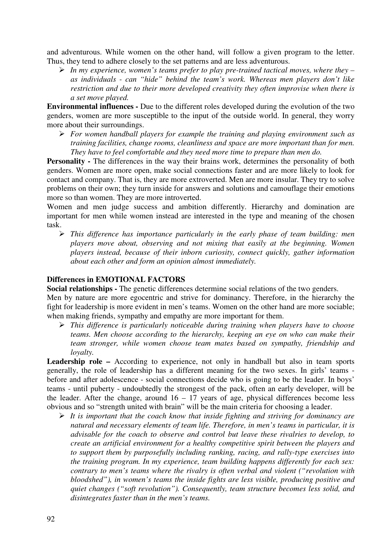
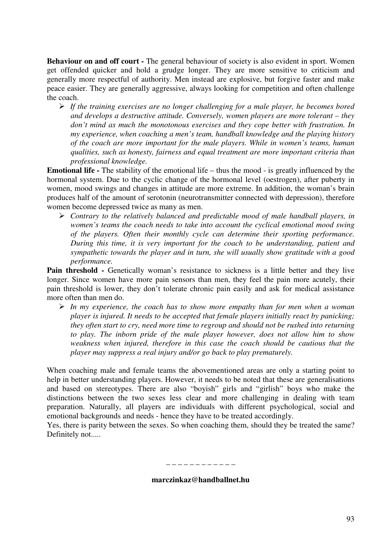
93 Behaviour on and off court The general behaviour of society is also evident in sport. Women get offended quicker and hold a grudge longer. They are more sensitive to criticism and generally more respectful of authority. Men instead are explosive, but forgive faster and make peace easier. They are generally aggressive, always looking for competition and often challenge the coach. If the training exercises are no longer challenging for a male player, he becomes bored and develops a destructive attitude. Conversely, women players are more tolerant – they don’t mind as much the monotonous exercises and they cope better with frustration. In my experience, when coaching a men’s team, handball knowledge and the playing history of the coach are more important for the male players. While in women’s teams, human qualities, such as honesty, fairness and equal treatment are more important criteria than professional knowledge. Emotional life The stability of the emotional life – thus the mood is greatly influenced by the hormonal system. Due to the cyclic change of the hormonal level (oestrogen), after puberty in women, mood swings and changes in attitude are more extreme. In addition, the woman’s brain produces half of the amount of serotonin (neurotransmitter connected with depression), therefore women become depressed twice as many as men. Contrary to the relatively balanced and predictable mood of male handball players, in women’s teams the coach needs to take into account the cyclical emotional mood swing of the players. Often their monthly cycle can determine their sporting performance. During this time, it is very important for the coach to be understanding, patient and sympathetic towards the player and in turn, she will usually show gratitude with a good performance. Pain threshold Genetically woman’s resistance to sickness is a little better and they live longer. Since women have more pain sensors than men, they feel the pain more acutely, their pain threshold is lower, they don’t tolerate chronic pain easily and ask for medical assistance more often than men do. In my experience, the coach has to show more empathy than for men when a woman player is injured. It needs to be accepted that female players initially react by panicking; they often start to cry, need more time to regroup and should not be rushed into returning to play. The inborn pride of the male player however, does not allow him to show weakness when injured, therefore in this case the coach should be cautious that the player may suppress a real injury and/or go back to play prematurely. When coaching male and female teams the abovementioned areas are only a starting point to help in better understanding players. However, it needs to be noted that these are generalisations and based on stereotypes. There are also “boyish” girls and “girlish” boys who make the distinctions between the two sexes less clear and more challenging in dealing with team preparation. Naturally, all players are individuals with different psychological, social and emotional backgrounds and needs hence they have to be treated accordingly. Yes, there is parity between the sexes. So when coaching them, should they be treated the same? Definitely not..... _ _ _ _ _ _ _ _ _ _ _ _ marczinkaz@handballnet.hu | |
 « |  » |
|
» Zur Flash-Version des Livebooks | |