| Volltext anzeigen | |
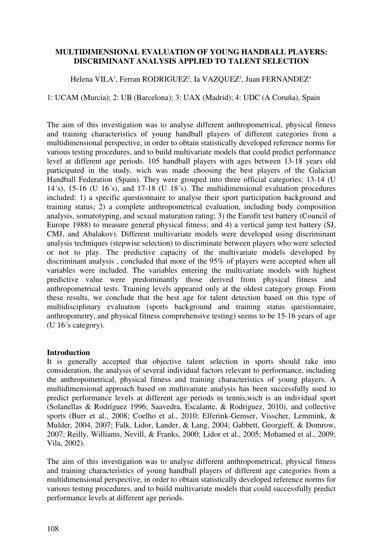
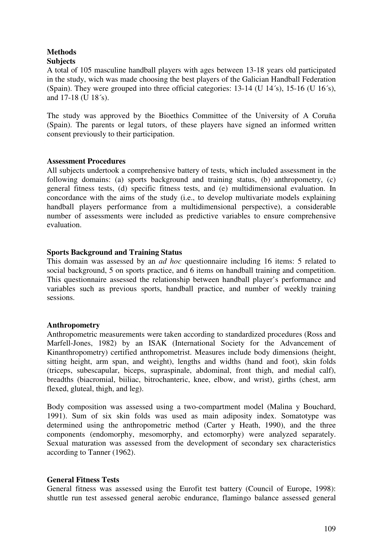
109 Methods Subjects A total of 105 masculine handball players with ages between 13-18 years old participated in the study, wich was made choosing the best players of the Galician Handball Federation (Spain). They were grouped into three official categories: 13-14 (U 14´s), 15-16 (U 16´s), and 17-18 (U 18´s). The study was approved by the Bioethics Committee of the University of A Coruña (Spain). The parents or legal tutors, of these players have signed an informed written consent previously to their participation. Assessment Procedures All subjects undertook a comprehensive battery of tests, which included assessment in the following domains: (a) sports background and training status, (b) anthropometry, (c) general fitness tests, (d) specific fitness tests, and (e) multidimensional evaluation. In concordance with the aims of the study (i.e., to develop multivariate models explaining handball players performance from a multidimensional perspective), a considerable number of assessments were included as predictive variables to ensure comprehensive evaluation. Sports Background and Training Status This domain was assessed by an ad hoc questionnaire including 16 items: 5 related to social background, 5 on sports practice, and 6 items on handball training and competition. This questionnaire assessed the relationship between handball player’s performance and variables such as previous sports, handball practice, and number of weekly training sessions. Anthropometry Anthropometric measurements were taken according to standardized procedures (Ross and Marfell-Jones, 1982) by an ISAK (International Society for the Advancement of Kinanthropometry) certified anthropometrist. Measures include body dimensions (height, sitting height, arm span, and weight), lengths and widths (hand and foot), skin folds (triceps, subescapular, biceps, supraspinale, abdominal, front thigh, and medial calf), breadths (biacromial, biiliac, bitrochanteric, knee, elbow, and wrist), girths (chest, arm flexed, gluteal, thigh, and leg). Body composition was assessed using a two-compartment model (Malina y Bouchard, 1991). Sum of six skin folds was used as main adiposity index. Somatotype was determined using the anthropometric method (Carter y Heath, 1990), and the three components (endomorphy, mesomorphy, and ectomorphy) were analyzed separately. Sexual maturation was assessed from the development of secondary sex characteristics according to Tanner (1962). General Fitness Tests General fitness was assessed using the Eurofit test battery (Council of Europe, 1998): shuttle run test assessed general aerobic endurance, flamingo balance assessed general | |
 « |  » |
|
» Zur Flash-Version des Livebooks | |