| Volltext anzeigen | |
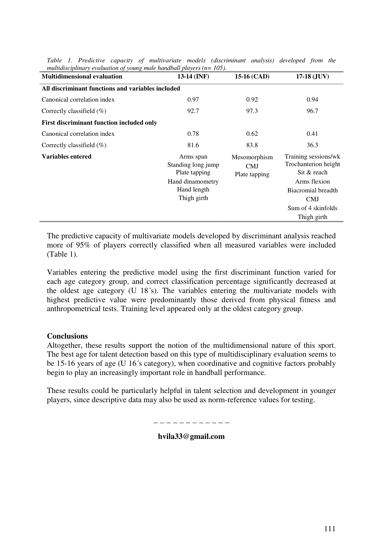
111 Table 1. Predictive capacity of multivariate models (discriminant analysis) developed from the multidisciplinary evaluation of young male handball players (n= 105). Multidimensional evaluation 13-14 (INF) 15-16 (CAD) 17-18 (JUV) All discriminant functions and variables included Canonical correlation index 0.97 0.92 0.94 Correctly classifield (%) 92.7 97.3 96.7 First discriminant function included only Canonical correlation index 0.78 0.62 0.41 Correctly classifield (%) 81.6 83.8 36.3 Variables entered Arms span Standing long jump Plate tapping Hand dinamometry Hand length Thigh girth Mesomorphism CMJ Plate tapping Training sessions/wk Trochanterion height Sit & reach Arms flexion Biacromial breadth CMJ Sum of 4 skinfolds Thigh girth The predictive capacity of multivariate models developed by discriminant analysis reached more of 95% of players correctly classified when all measured variables were included (Table 1). Variables entering the predictive model using the first discriminant function varied for each age category group, and correct classification percentage significantly decreased at the oldest age category (U 18´s). The variables entering the multivariate models with highest predictive value were predominantly those derived from physical fitness and anthropometrical tests. Training level appeared only at the oldest category group. Conclusions Altogether, these results support the notion of the multidimensional nature of this sport. The best age for talent detection based on this type of multidisciplinary evaluation seems to be 15-16 years of age (U 16´s category), when coordinative and cognitive factors probably begin to play an increasingly important role in handball performance. These results could be particularly helpful in talent selection and development in younger players, since descriptive data may also be used as norm-reference values for testing. hvila33@gmail.com | |
 « |  » |
|
» Zur Flash-Version des Livebooks | |