| Volltext anzeigen | |
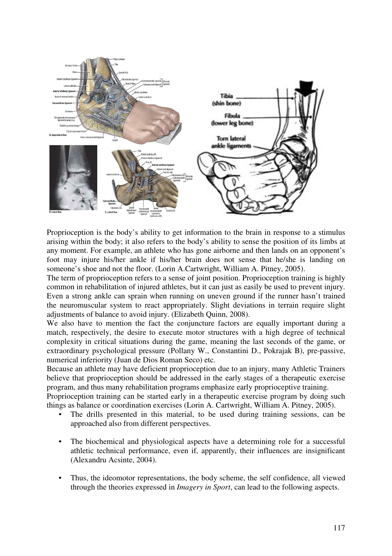
117 Proprioception is the body’s ability to get information to the brain in response to a stimulus arising within the body; it also refers to the body’s ability to sense the position of its limbs at any moment. For example, an athlete who has gone airborne and then lands on an opponent’s foot may injure his/her ankle if his/her brain does not sense that he/she is landing on someone’s shoe and not the floor. (Lorin A.Cartwright, William A. Pitney, 2005). The term of proprioception refers to a sense of joint position. Proprioception training is highly common in rehabilitation of injured athletes, but it can just as easily be used to prevent injury. Even a strong ankle can sprain when running on uneven ground if the runner hasn’t trained the neuromuscular system to react appropriately. Slight deviations in terrain require slight adjustments of balance to avoid injury. (Elizabeth Quinn, 2008). We also have to mention the fact the conjuncture factors are equally important during a match, respectively, the desire to execute motor structures with a high degree of technical complexity in critical situations during the game, meaning the last seconds of the game, or extraordinary psychological pressure (Pollany W., Constantini D., Pokrajak B), pre-passive, numerical inferiority (Juan de Dios Roman Seco) etc. Because an athlete may have deficient proprioception due to an injury, many Athletic Trainers believe that proprioception should be addressed in the early stages of a therapeutic exercise program, and thus many rehabilitation programs emphasize early proprioceptive training. Proprioception training can be started early in a therapeutic exercise program by doing such things as balance or coordination exercises (Lorin A. Cartwright, William A. Pitney, 2005). • The drills presented in this material, to be used during training sessions, can be approached also from different perspectives. • The biochemical and physiological aspects have a determining role for a successful athletic technical performance, even if, apparently, their influences are insignificant (Alexandru Acsinte, 2004). • Thus, the ideomotor representations, the body scheme, the self confidence, all viewed through the theories expressed in Imagery in Sport, can lead to the following aspects. | |
 « |  » |
|
» Zur Flash-Version des Livebooks | |