| Volltext anzeigen | |
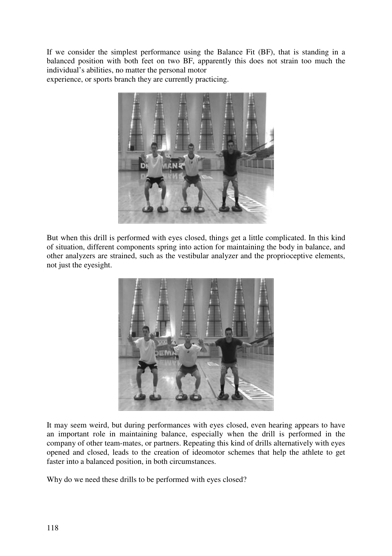
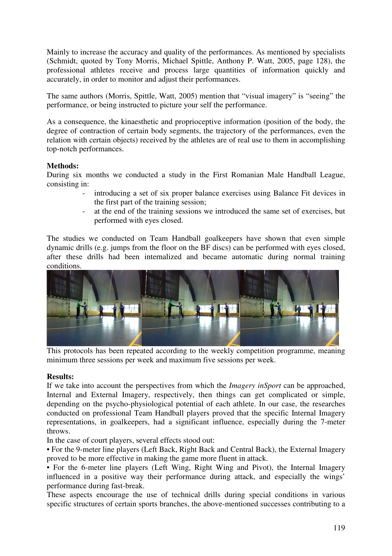
119 Mainly to increase the accuracy and quality of the performances. As mentioned by specialists (Schmidt, quoted by Tony Morris, Michael Spittle, Anthony P. Watt, 2005, page 128), the professional athletes receive and process large quantities of information quickly and accurately, in order to monitor and adjust their performances. The same authors (Morris, Spittle, Watt, 2005) mention that “visual imagery” is “seeing” the performance, or being instructed to picture your self the performance. As a consequence, the kinaesthetic and proprioceptive information (position of the body, the degree of contraction of certain body segments, the trajectory of the performances, even the relation with certain objects) received by the athletes are of real use to them in accomplishing top-notch performances. Methods: During six months we conducted a study in the First Romanian Male Handball League, consisting in: introducing a set of six proper balance exercises using Balance Fit devices in the first part of the training session; at the end of the training sessions we introduced the same set of exercises, but performed with eyes closed. The studies we conducted on Team Handball goalkeepers have shown that even simple dynamic drills (e.g. jumps from the floor on the BF discs) can be performed with eyes closed, after these drills had been internalized and became automatic during normal training conditions. This protocols has been repeated according to the weekly competition programme, meaning minimum three sessions per week and maximum five sessions per week. Results: If we take into account the perspectives from which the Imagery inSport can be approached, Internal and External Imagery, respectively, then things can get complicated or simple, depending on the psycho-physiological potential of each athlete. In our case, the researches conducted on professional Team Handball players proved that the specific Internal Imagery representations, in goalkeepers, had a significant influence, especially during the 7-meter throws. In the case of court players, several effects stood out: • For the 9-meter line players (Left Back, Right Back and Central Back), the External Imagery proved to be more effective in making the game more fluent in attack. • For the 6-meter line players (Left Wing, Right Wing and Pivot), the Internal Imagery influenced in a positive way their performance during attack, and especially the wings’ performance during fast-break. These aspects encourage the use of technical drills during special conditions in various specific structures of certain sports branches, the above-mentioned successes contributing to a | |
 « |  » |
|
» Zur Flash-Version des Livebooks | |