| Volltext anzeigen | |
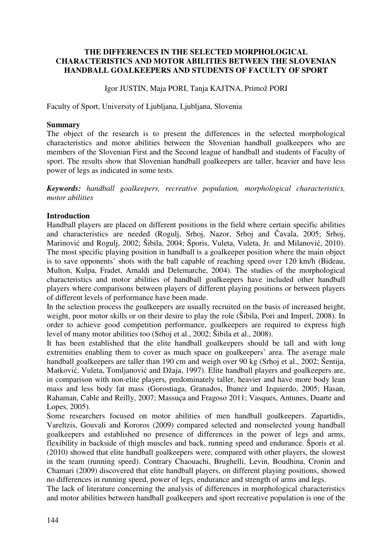
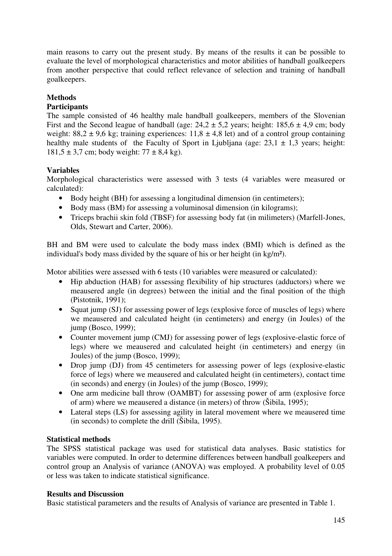
145 main reasons to carry out the present study. By means of the results it can be possible to evaluate the level of morphological characteristics and motor abilities of handball goalkeepers from another perspective that could reflect relevance of selection and training of handball goalkeepers. Methods Participants The sample consisted of 46 healthy male handball goalkeepers, members of the Slovenian First and the Second league of handball (age: 24,2 ± 5,2 years; height: 185,6 ± 4,9 cm; body weight: 88,2 ± 9,6 kg; training experiences: 11,8 ± 4,8 let) and of a control group containing healthy male students of the Faculty of Sport in Ljubljana (age: 23,1 ± 1,3 years; height: 181,5 ± 3,7 cm; body weight: 77 ± 8,4 kg). Variables Morphological characteristics were assessed with 3 tests (4 variables were measured or calculated): • Body height (BH) for assessing a longitudinal dimension (in centimeters); • Body mass (BM) for assessing a voluminosal dimension (in kilograms); • Triceps brachii skin fold (TBSF) for assessing body fat (in milimeters) (Marfell-Jones, Olds, Stewart and Carter, 2006). BH and BM were used to calculate the body mass index (BMI) which is defined as the individual's body mass divided by the square of his or her height (in kg/m²). Motor abilities were assessed with 6 tests (10 variables were measured or calculated): • Hip abduction (HAB) for assessing flexibility of hip structures (adductors) where we meausered angle (in degrees) between the initial and the final position of the thigh (Pistotnik, 1991); • Squat jump (SJ) for assessing power of legs (explosive force of muscles of legs) where we meausered and calculated height (in centimeters) and energy (in Joules) of the jump (Bosco, 1999); • Counter movement jump (CMJ) for assessing power of legs (explosive-elastic force of legs) where we meausered and calculated height (in centimeters) and energy (in Joules) of the jump (Bosco, 1999); • Drop jump (DJ) from 45 centimeters for assessing power of legs (explosive-elastic force of legs) where we meausered and calculated height (in centimeters), contact time (in seconds) and energy (in Joules) of the jump (Bosco, 1999); • One arm medicine ball throw (OAMBT) for assessing power of arm (explosive force of arm) where we meausered a distance (in meters) of throw (Šibila, 1995); • Lateral steps (LS) for assessing agility in lateral movement where we meausered time (in seconds) to complete the drill (Šibila, 1995). Statistical methods The SPSS statistical package was used for statistical data analyses. Basic statistics for variables were computed. In order to determine differences between handball goalkeepers and control group an Analysis of variance (ANOVA) was employed. A probability level of 0.05 or less was taken to indicate statistical significance. Results and Discussion Basic statistical parameters and the results of Analysis of variance are presented in Table 1. | |
 « |  » |
|
» Zur Flash-Version des Livebooks | |