| Volltext anzeigen | |
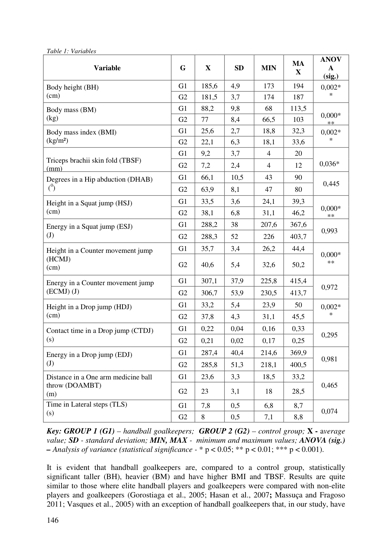
147 higher TBSF than a control group of students. That is similar to results of studies where handball goalkeepers had more pronounced skin folds (body fat) than the players from other playing positions (Srhoj et al., 2002; Šibila and Pori, 2009; Šporis et al., 2010). Higher value of the BH primary helps goalkeepers to stop shots directed at the upper corners of the goal (Šibila and Pori, 2009). Handball goalkeepers also have higher BM and BMI that do not illustrate only the higher body lean mass but also the higher subcutaneous fat (TBSF). In SJ, CMJ and DJ the energy produced by participants was calculated. The energy depends on body mass and the initial velocity at the jumps (Energy = ½ * mass * velocity²) (Enoka, 1994). Handball goalkeepers produce the similar energy as a control group but they have to move with more body mass, what results in a lower initial velocity and the height of the jumps. In the terms of body composition, in a case of a not very high level of strength and power, a faster reaction and movement can be expected when the body and limbs are not heavy due to the smaller moment of inertia (Enoka, 1994). Body fat can represent an additional burden. Muscle mass is desirable from the point of view of reaction and movement speed so far, until positive contribute to the speed and power of goalkeepers’ movements. A high level of power of arms and legs in optimal combination with a body mass is assumed to be very important for the goalkeepers. There are not any statistically significant differences between the handball goalkeepers and a control group in the results of the tests HAB, OAMBT and LS. As it can be seen from the results in LS, the handball goalkeepers are faster and yet not statistically significant. Lateral agility is important especially during the defense of shots from longer distances (GuiterresDavila, Rojas, Ortega, Campos and Parraga, 2011). Similar findings were reported by Šibila, Justin, Pori, Kajtna and Pori (2010) who investigated goalkeepers of different competition level and Zapartidis et. al. (2009) who compared selected and nonselected young handball goalkeepers. Šibila et al. (2010) reported that the only difference was in the test OAMBT where goalkeepers, who compete on higher level, achieved better results. We measured the contact time in DJ where no differences between handball goalkeepers and control group have been seen. By equal time of taking off, students jump higher (HDJ), what can represents an advantage because, at the same time, they can reach a far more distant point. But handball goalkeepers are taller, so it is difficult to say who has an advantage. Conclusions Certain studies have shown that a condition of male handball goalkeepers is not at high level. The results of the present study in some way confirm the results of these studies. When compared to male students of Faculty of Sport, handball goalkeepers have less power of legs as indicated in some tests and the similar level of other abilities. The cause for such results can be the body mass, as handball goalkeepers are much heavier and have more subcutaneous fat. From the perspective including these abilities and characteristics, the students of Faculty of Sport have a better potencial to be the handball goalkeepers. But handball goalkeepers have an advantage in body height; nevertheless it is hard to say who has a better potential from the aspect of morphological characteristics and motor abilities. In conclusion, a tall body and a high level of power of arms and legs in optimal combination with a body mass are assumed to be very important for the handball goalkeepers. _ _ _ _ _ _ _ _ _ _ _ _ igorjustin@gmail.com | |
 « |  » |
|
» Zur Flash-Version des Livebooks | |