| Volltext anzeigen | |
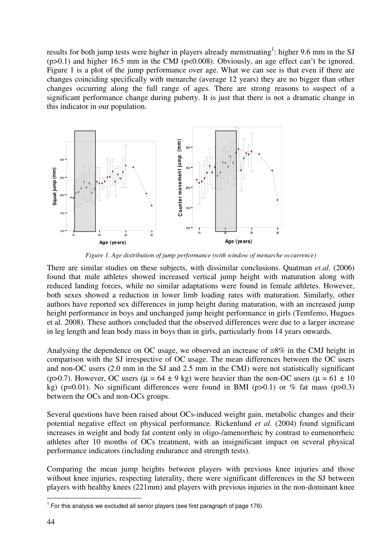
45 (243mm) – ANOVA: p<0.04; HSD: p<0.022. These differences are not statistically significant in the case of the CMJ (marginally, p>0.057). Isokinetic Strength of Hamstrings/Quadriceps The sub-sample of players which participate in this study was subdivided into 3 groups: those with no previous history of ACL injuries (N=91), those with previous or chronic ACL injury (N=9) and those that in the following year suffered an ACL rupture (N=4). Players with no previous history of ACL injury After normalization to body weight the isokinetic evaluation at 90º/s revealed an (H:Q)conc ratio of 45%±7% what is regarded by some as a low value and an ACL risk factor (Hewett, Myer et al. 2001). This ratio is statistically different (p<3.3%, N=82) between nondominant and dominant limbs (46% vs 45%) but this asymmetry is insignificant from an epidemiological and biomechanical viewpoint (Hewett, Myer et al. 2001). Other nondominant-dominant asymmetries statistically significant (p<5%) but also biomechanically inconsequent (Hewett, Myer et al. 2001) regard the extension peak torque and total flexion work. For both dominant and nondominant limbs the (H:Q)conc ratio seem to increase along with the playing categories, particularly until the Juniors category, but in any of the cases the differences were not statistically significant (p>5%). The Juniors presented the highest (H:Q)conc ratio (48%±6%), particularly at the nondominant lower limb. Curiously the majority of the ACL ruptures studied in our work (Estriga 2008) occurred in the nondominant limb and in players up to 19 years old (Juniors or below). Analysing the quantities by playing position for the specialization categories (Juniors and Seniors) one can see a remarkable difference between the goalkeepers and the field players. However the sub-sample is very inhomogeneous with just 4 goalkeepers (of the 11 tested), 8 pivots and 39 field players. We have found no statistically significant differences between any groups, but possibly the very small sample size for the goalkeepers affected the conclusions. However, a laterality analysis (paired samples) found asymmetric H:Q values for the field players (p<4.8%) and asymmetric extensors peak torque for the pivots (p<3.5%). This only makes us hypothesize the existence of a connection between the specific load of playing and the muscular adaptation. In any case, further work on this should be done with larger sample sizes and with more specific tests. Players with previous history of ACL injury reconstruction This small (N=9) group was composed of 8 Senior players (1 goalkeeper and 7 field players) and one Junior player (field player). They had sustained an ACL rupture and subsequent reconstructive surgery, on average, 4 years ago (1 to 7 years). There is no significant injured – non-injured leg asymmetry in this population in any of the isokinetically measured parameters. However there is a significant difference (p<1.7%) in the extension peak torque between the injured leg of this group (203 mm) and the nondominant leg of the general population (group with no previous ACL injuries) in the same age category (231 mm). The knee where reconstructive surgery was performed shows, 4 years later on average, about 10% reduction of the extension peak torque, but no reduction in the extension work (there is even a non significant increase). The current practice of using segments of the patellar ligament for the ACL reconstruction may, or may not, have some role on this. In any case it seems fair to say that, in our population, players who underwent an ACL reconstruction and returned to handball practice, did not recover completely even after an average of 4 years post surgery. This is in agreement | |
 « |  » |
|
» Zur Flash-Version des Livebooks | |