| Volltext anzeigen | |
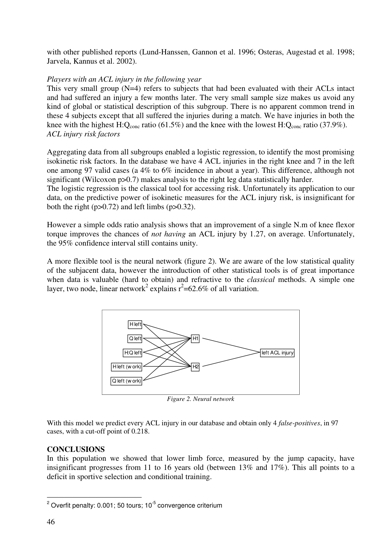
47 These players are subjected to the competitive loads (even international) but have to carry the added weight and body fat content while showing lower conditional capacity e.g. to avoid risk situations, to dynamically stabilize the knee, etc. They are exposed to a high dynamic risk of knee injury. We have characterized the Portuguese female handball population on some of its isokinetic parameters. We have established some slight associations between the handball career evolution, some isokinetic quantities and the ACL injury risk. Our results, although based on weak data, contradict the H:Q risk hypothesis. According to our model, the hamstrings peak torque alone is a better indicator of ACL injury risk. We concluded that the ACL injury (even with surgical reconstruction) may take a long time to recover, at least the isokinetic muscle function parameters. Practical implications To our understanding, this type of knowledge is important also for coaches, who are responsible and interested in promoting the safety and physical integrity of the players. Handball coaches, well informed about the injury problems, are in a better position to adopt efforts for preventing injuries, and to make educated decisions about reintegration in the training process and competition of clinically recovered players, and therefore decreasing the likelihood of reinjury in players. _ _ _ _ _ _ _ _ _ _ _ _ lestriga@fade.up.pt | |
 « |  » |
|
» Zur Flash-Version des Livebooks | |