| Volltext anzeigen | |
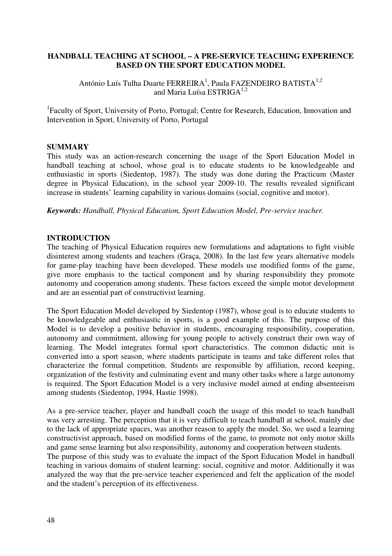
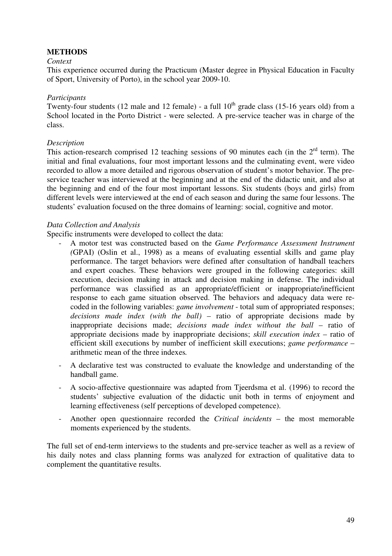
49 METHODS Context This experience occurred during the Practicum (Master degree in Physical Education in Faculty of Sport, University of Porto), in the school year 2009-10. Participants Twenty-four students (12 male and 12 female) a full 10th grade class (15-16 years old) from a School located in the Porto District were selected. A pre-service teacher was in charge of the class. Description This action-research comprised 12 teaching sessions of 90 minutes each (in the 2rd term). The initial and final evaluations, four most important lessons and the culminating event, were video recorded to allow a more detailed and rigorous observation of student’s motor behavior. The preservice teacher was interviewed at the beginning and at the end of the didactic unit, and also at the beginning and end of the four most important lessons. Six students (boys and girls) from different levels were interviewed at the end of each season and during the same four lessons. The students’ evaluation focused on the three domains of learning: social, cognitive and motor. Data Collection and Analysis Specific instruments were developed to collect the data: A motor test was constructed based on the Game Performance Assessment Instrument (GPAI) (Oslin et al., 1998) as a means of evaluating essential skills and game play performance. The target behaviors were defined after consultation of handball teachers and expert coaches. These behaviors were grouped in the following categories: skill execution, decision making in attack and decision making in defense. The individual performance was classified as an appropriate/efficient or inappropriate/inefficient response to each game situation observed. The behaviors and adequacy data were recoded in the following variables: game involvement total sum of appropriated responses; decisions made index (with the ball) – ratio of appropriate decisions made by inappropriate decisions made; decisions made index without the ball – ratio of appropriate decisions made by inappropriate decisions; skill execution index – ratio of efficient skill executions by number of inefficient skill executions; game performance – arithmetic mean of the three indexes. A declarative test was constructed to evaluate the knowledge and understanding of the handball game. A socio-affective questionnaire was adapted from Tjeerdsma et al. (1996) to record the students’ subjective evaluation of the didactic unit both in terms of enjoyment and learning effectiveness (self perceptions of developed competence). Another open questionnaire recorded the Critical incidents – the most memorable moments experienced by the students. The full set of end-term interviews to the students and pre-service teacher as well as a review of his daily notes and class planning forms was analyzed for extraction of qualitative data to complement the quantitative results. | |
 « |  » |
|
» Zur Flash-Version des Livebooks | |