| Volltext anzeigen | |
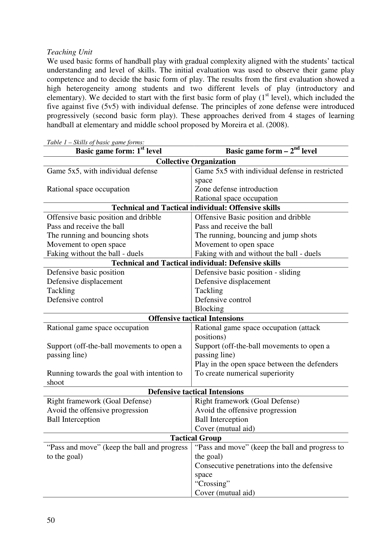
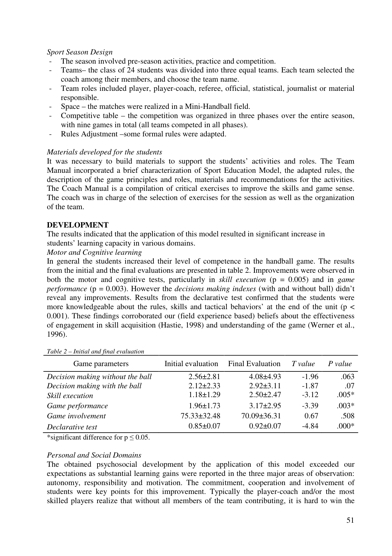
51 Sport Season Design The season involved pre-season activities, practice and competition. Teams– the class of 24 students was divided into three equal teams. Each team selected the coach among their members, and choose the team name. Team roles included player, player-coach, referee, official, statistical, journalist or material responsible. Space – the matches were realized in a Mini-Handball field. Competitive table – the competition was organized in three phases over the entire season, with nine games in total (all teams competed in all phases). Rules Adjustment –some formal rules were adapted. Materials developed for the students It was necessary to build materials to support the students’ activities and roles. The Team Manual incorporated a brief characterization of Sport Education Model, the adapted rules, the description of the game principles and roles, materials and recommendations for the activities. The Coach Manual is a compilation of critical exercises to improve the skills and game sense. The coach was in charge of the selection of exercises for the session as well as the organization of the team. DEVELOPMENT The results indicated that the application of this model resulted in significant increase in students’ learning capacity in various domains. Motor and Cognitive learning In general the students increased their level of competence in the handball game. The results from the initial and the final evaluations are presented in table 2. Improvements were observed in both the motor and cognitive tests, particularly in skill execution (p = 0.005) and in game performance (p = 0.003). However the decisions making indexes (with and without ball) didn’t reveal any improvements. Results from the declarative test confirmed that the students were more knowledgeable about the rules, skills and tactical behaviors’ at the end of the unit (p < 0.001). These findings corroborated our (field experience based) beliefs about the effectiveness of engagement in skill acquisition (Hastie, 1998) and understanding of the game (Werner et al., 1996). Table 2 – Initial and final evaluation Game parameters Initial evaluation Final Evaluation T value P value Decision making without the ball 2.56±2.81 4.08±4.93 -1.96 .063 Decision making with the ball 2.12±2.33 2.92±3.11 -1.87 .07 Skill execution 1.18±1.29 2.50±2.47 -3.12 .005* Game performance 1.96±1.73 3.17±2.95 -3.39 .003* Game involvement 75.33±32.48 70.09±36.31 0.67 .508 Declarative test 0.85±0.07 0.92±0.07 -4.84 .000* *significant difference for p ≤ 0.05. Personal and Social Domains The obtained psychosocial development by the application of this model exceeded our expectations as substantial learning gains were reported in the three major areas of observation: autonomy, responsibility and motivation. The commitment, cooperation and involvement of students were key points for this improvement. Typically the player-coach and/or the most skilled players realize that without all members of the team contributing, it is hard to win the | |
 « |  » |
|
» Zur Flash-Version des Livebooks | |