| Volltext anzeigen | |
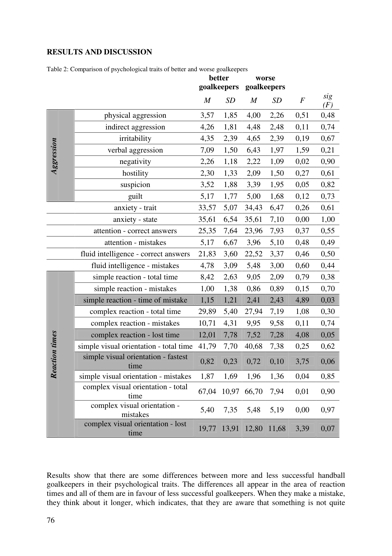
77 right. They lose less time in deciding upon the correct answer in complex situations, they have faster response times in simple selection tasks and also lose less time in complex tasks, that require visual orientation. Less successful goalkeepers were faster in synchronizing arm and leg movement, spent their time more rationally, which could be explained with the individual characteristics of the athletes (for example health status, body temperature, age, mielinization of neurons, alertness…), which can affect the speed of response of an athlete (Jeromen, Barić & Kajtna, 2010). Less successful athletes were significantly younger than their more successful colleagues. Numerous studies have shown that younger participants have faster simple reaction times (Charness & Campbell, 1988; Geary & Wiley, 1991; Geary et al., 1993; Rogers& Fisk, 1991; Salthouse & Coon, 1994, all as cited in Salthouse, 2000), as well as faster complex reaction times (Horn & Masunanga, 2006). The other possible explanation would be that better (also older players with longer careers) have endured more injuries to the locomotory system, which could affect the functioning of the nervous system and the speed of the nervous – muscular reaction. It is known that health status and the mielinization of neurons can affect the speed of response (Jeromen et al., 2010). The next possible explanation could be that better goalkeepers were less motivated for the measurements and thus less successful – the younger and less successful goalkeepers might try to prove themselves more in an environment, which attempts to simulate the response in the game – responding to an appearing visual stimuli. Motivation, agility and attention increase the speed of reaction (Jeromen et al.,2010) and preparatory attention plays an important role, since it increases the level of activation and enables a faster response (LaBerge, 1995, as cited in Korošec, 2002). More successful goalkeepers should be more experienced tactically – tactical knowledge and experience have a great influence on success, equally to response times (Lipkova, Štulrajter, Norovskyjev in Miklanek, 1997) – in our case, it seems that perhaps the specific knowledge and tactical experience outweighed the reaction times, since not only were the groups equal, but even the less successful goalkeepers were better. Both groups were equally efficient in selection and distraction avoidance tasks, which they faced in the test of attention a similar finding was discovered by Memmert, Simons and Grimme (2009). No differences were found also in the testing of anxiety and aggression and fluid intelligence. Perhaps one of the reasons are the sample characteristics. Despite the fact that the sample was fairly large with respect to the entire population of Slovene handball goalkeepers, the very best ones were not available for testing, since they are playing abroad. That means that the goalkeepers participating in research were not really that different in quality, which of course would explain the lack of differences. It also raises the question of the expert evaluation of the quality – the problem was lack of useful statistical data on which to base the division into better or less successful goalkeepers. These are some issues that future research in the field should address – obtain results also form the best goalkeepers and look to some statistical data to help us divide the goalkeepers in both groups. _ _ _ _ _ _ _ _ _ _ _ _ Tanja.Kajtna@fsp.uni-lj.si | |
 « |  » |
|
» Zur Flash-Version des Livebooks | |