| Volltext anzeigen | |
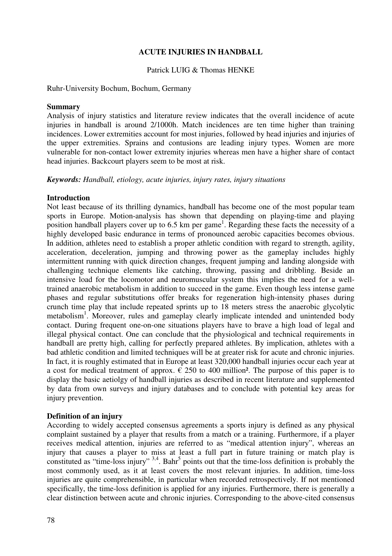
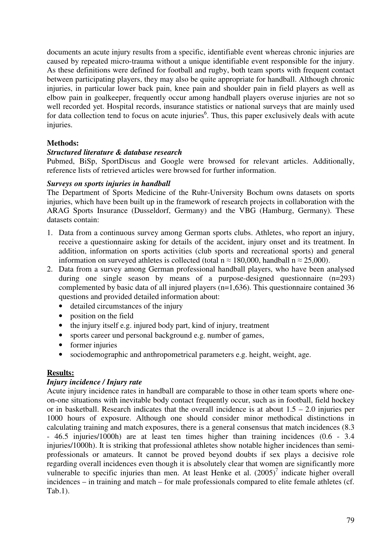
79 documents an acute injury results from a specific, identifiable event whereas chronic injuries are caused by repeated micro-trauma without a unique identifiable event responsible for the injury. As these definitions were defined for football and rugby, both team sports with frequent contact between participating players, they may also be quite appropriate for handball. Although chronic injuries, in particular lower back pain, knee pain and shoulder pain in field players as well as elbow pain in goalkeeper, frequently occur among handball players overuse injuries are not so well recorded yet. Hospital records, insurance statistics or national surveys that are mainly used for data collection tend to focus on acute injuries6. Thus, this paper exclusively deals with acute injuries. Methods: Structured literature & database research Pubmed, BiSp, SportDiscus and Google were browsed for relevant articles. Additionally, reference lists of retrieved articles were browsed for further information. Surveys on sports injuries in handball The Department of Sports Medicine of the Ruhr-University Bochum owns datasets on sports injuries, which have been built up in the framework of research projects in collaboration with the ARAG Sports Insurance (Dusseldorf, Germany) and the VBG (Hamburg, Germany). These datasets contain: 1. Data from a continuous survey among German sports clubs. Athletes, who report an injury, receive a questionnaire asking for details of the accident, injury onset and its treatment. In addition, information on sports activities (club sports and recreational sports) and general information on surveyed athletes is collected (total n ≈ 180,000, handball n ≈ 25,000). 2. Data from a survey among German professional handball players, who have been analysed during one single season by means of a purpose-designed questionnaire (n=293) complemented by basic data of all injured players (n=1,636). This questionnaire contained 36 questions and provided detailed information about: • detailed circumstances of the injury • position on the field • the injury itself e.g. injured body part, kind of injury, treatment • sports career und personal background e.g. number of games, • former injuries • sociodemographic and anthropometrical parameters e.g. height, weight, age. Results: Injury incidence / Injury rate Acute injury incidence rates in handball are comparable to those in other team sports where oneon-one situations with inevitable body contact frequently occur, such as in football, field hockey or in basketball. Research indicates that the overall incidence is at about 1.5 – 2.0 injuries per 1000 hours of exposure. Although one should consider minor methodical distinctions in calculating training and match exposures, there is a general consensus that match incidences (8.3 46.5 injuries/1000h) are at least ten times higher than training incidences (0.6 3.4 injuries/1000h). It is striking that professional athletes show notable higher incidences than semiprofessionals or amateurs. It cannot be proved beyond doubts if sex plays a decisive role regarding overall incidences even though it is absolutely clear that women are significantly more vulnerable to specific injuries than men. At least Henke et al. (2005)7 indicate higher overall incidences – in training and match – for male professionals compared to elite female athletes (cf. Tab.1). | |
 « |  » |
|
» Zur Flash-Version des Livebooks | |